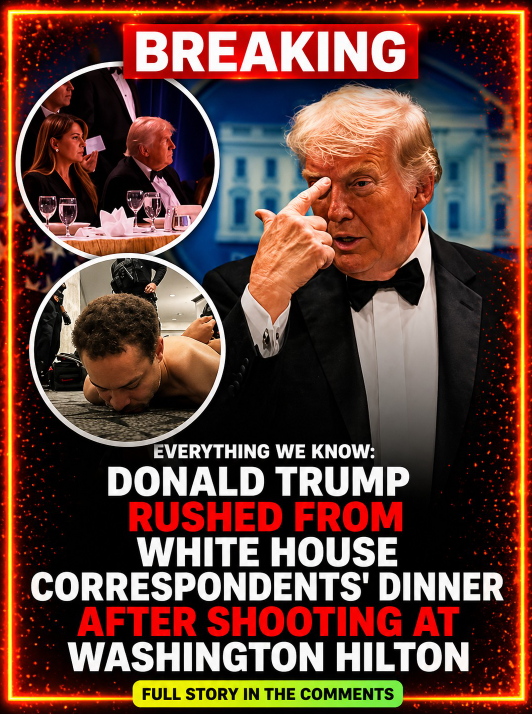
The dramatic headline—Donald Trump rushed from the White House Correspondents’ Dinner after a shooting at the Washington Hilton—is grounded in real events. But like many fast-moving breaking stories, the full picture is more detailed, more structured, and less chaotic than it might first appear.
Here’s a clear, comprehensive breakdown of everything we know so far.
The setting: a high-security, high-profile event
The White House Correspondents’ Dinner is one of the most prominent gatherings in Washington. Held at the Washington Hilton, it typically draws thousands of attendees, including top journalists, celebrities, and senior government officials.
In 2026, the stakes were even higher because Donald Trump attended the dinner as sitting president—something he had often skipped in the past. That meant an even heavier security presence, including multiple layers of screening and armed protection coordinated by the United States Secret Service.
How the incident unfolded
According to verified reports, the situation escalated quickly around 8:30–8:40 p.m. ET.
- Guests inside the ballroom suddenly heard what sounded like gunshots
- Security personnel immediately reacted, shouting warnings and initiating emergency protocols
- Many attendees instinctively ducked under tables or froze in place
Outside the ballroom, investigators say a lone suspect approached and then charged a security checkpoint in the hotel lobby area.
The individual was reportedly armed with multiple weapons, including a shotgun, handgun, and knives, and fired during a confrontation with security.
Trump rushed from the stage
Inside the ballroom, the response was immediate and highly coordinated.
Secret Service agents moved quickly toward Trump, forming a protective perimeter and escorting him off the stage within seconds. This is what many headlines describe as him being “rushed” away.
While the moment looked dramatic, it followed standard presidential protection protocol:
- Shield the president
- Remove him from the exposed area
- Relocate to a secure location
Trump was not directly confronted by the shooter. Instead, he was evacuated as a precaution while the threat was still being assessed.
Other high-profile attendees—including cabinet members and the first lady—were also moved to safety.
What happened to the suspect
Law enforcement quickly contained the situation.
- The suspect was stopped before reaching the ballroom
- He was subdued and taken into custody at the scene
- Authorities believe he acted alone
Federal charges were announced shortly afterward, including assault on a federal officer and firearms-related offenses.
Early indications suggest the suspect may have been targeting government officials, though the exact motive is still under investigation.
Injuries and immediate aftermath
Despite the seriousness of the situation, the outcome could have been far worse.
- No fatalities were reported
- One federal agent was struck but protected by a bullet-resistant vest and survived
- Trump and all major attendees were unharmed
Inside the ballroom, scenes of confusion gave way to controlled evacuation. Some guests were escorted out, while others were temporarily held in secure areas as law enforcement cleared the building.
The event itself was ultimately cut short and postponed.
Why the location matters
There’s an eerie historical layer to this story.
The Washington Hilton is the same venue where Ronald Reagan was shot in 1981. That history is one reason security at the dinner is typically so tight.
Even so, this incident shows how determined individuals can still exploit small gaps, especially in large, complex events involving thousands of people.
Was this an assassination attempt?
This is where nuance matters.
Some reports and commentators have described the incident as a possible assassination attempt. Others have been more cautious.
What’s confirmed:
- The suspect was armed
- He fired shots near a high-profile political gathering
- He may have been targeting officials
What is not fully confirmed:
- A specific plan to assassinate Trump personally
- Whether Trump himself was the direct target
So while the situation was extremely serious, officials are still working to determine intent.
Trump’s response
After being moved to safety, Trump later addressed the incident publicly.
He praised the Secret Service and law enforcement response, calling it fast and effective, and acknowledged the risks that come with public office.
At one point, he even suggested the event might continue—but authorities ultimately decided to shut it down for safety reasons.
The bigger picture
Beyond the immediate घटना, this moment highlights several broader realities:
1. Security systems worked—but were tested
The suspect was stopped before reaching the main event, showing the system functioned—but also that it was challenged.
2. High-profile events remain vulnerable
Even with multiple security layers, large gatherings create complex environments that are difficult to fully control.
3. Information spreads faster than facts
Within minutes, social media was flooded with:
- Claims of multiple shooters
- Assertions of a confirmed assassination attempt
- Exaggerated or false details
Many of those claims remain unverified or incorrect.
Final takeaway
Here’s the grounded reality:
- Shots were fired near the Washington Hilton during the Correspondents’ Dinner
- Donald Trump was quickly escorted off stage as a precaution
- A suspect was captured before reaching the ballroom
- One officer was injured but survived
- No attendees, including Trump, were harmed
What could have become a catastrophic event was contained within minutes.
And while the images of a president being rushed from a stage are powerful, the deeper story is about rapid response, layered security, and a situation brought under control before it escalated further.