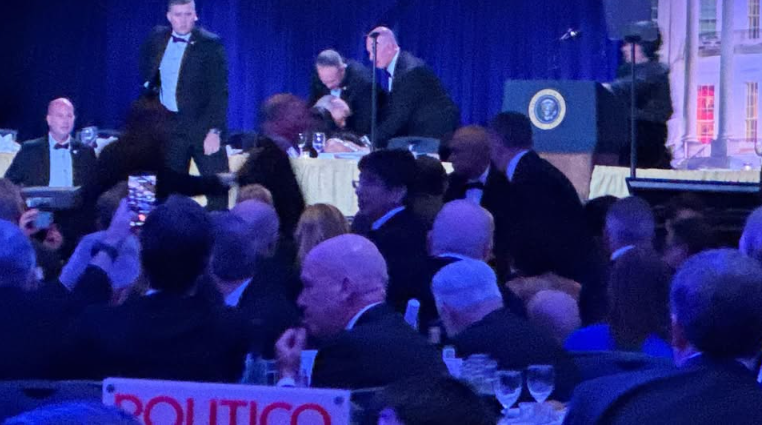
Donald Trump being rushed off stage during the White House Correspondents’ Dinner is the kind of moment that instantly captures national attention—partly because of who is involved, and partly because of what it represents. But beyond the dramatic phrasing, the full story reveals a fast-moving security response to a potentially dangerous situation that was ultimately contained.
The White House Correspondents’ Dinner has long been one of the most recognizable political and media gatherings in the United States. Each year, journalists, government officials, and prominent public figures come together in a setting that blends satire, speeches, and symbolism. It’s one of the few occasions where political rivals and members of the press share the same room in a relatively relaxed atmosphere—at least on the surface.
That atmosphere shifted abruptly on the night of the incident.
According to early accounts, the disruption began outside the main ballroom area, where layers of security were already in place. A man approached a restricted zone near an entrance checkpoint, drawing the attention of security personnel. Within seconds, the situation escalated. Witnesses described hearing sharp, loud sounds—later confirmed to be gunfire—triggering an immediate response from law enforcement and protective agents.
Inside the venue, the mood changed instantly. What had been a formal, high-profile gathering became a scene of controlled urgency. Security personnel moved with precision, communicating through earpieces, guiding attendees, and initiating protective protocols designed specifically for moments like this.
Trump, who was either speaking or preparing to speak at the time depending on the report, was quickly identified as a priority for evacuation. Agents from the United States Secret Service surrounded him and escorted him off stage within moments. The movement may have appeared sudden to observers, but it followed a rehearsed and highly structured procedure meant to minimize risk.
To those in attendance, the experience was surreal. Some initially thought the noises were part of the program—perhaps a sound effect or an unexpected interruption. But the speed and seriousness of the security response made it clear that something was wrong. Guests were directed to exits or instructed to remain in secure areas while the situation outside was assessed.
Meanwhile, outside the ballroom, law enforcement confronted the suspect. Details are still emerging, but officials have indicated that the individual was armed and engaged in a brief but intense encounter with security personnel. Shots were fired during this confrontation, though it remains under investigation exactly who discharged their weapon first.
What is clear is that the suspect was quickly subdued and taken into custody before gaining access to the main event space. This rapid containment was critical. Had the individual breached the inner perimeter, the situation could have escalated dramatically.
Reports also indicate that at least one officer was struck during the incident but was protected by a bullet-resistant vest. The officer’s survival underscores both the risks faced by security personnel and the importance of the protective measures in place.
Within a relatively short period, authorities secured the area and began piecing together what had happened. Trump was later confirmed to be safe and unharmed, and communication was sent out to reassure attendees and the public.
Still, the phrase “rushed off stage” continued to dominate headlines.
It’s a phrase that carries a sense of urgency—and understandably so. But it can also create a misleading impression if taken out of context. Trump was not directly confronted by the shooter, nor was he in immediate line of fire. The evacuation was precautionary, executed exactly as designed by the security teams responsible for his protection.
In the hours following the incident, information spread rapidly across social media platforms. As often happens, speculation filled the gaps left by incomplete details. Some posts described the event as a direct assassination attempt, while others suggested coordinated attacks or multiple suspects.
So far, officials have not confirmed those claims.
Instead, early findings suggest that the suspect acted alone and was stopped before reaching the central gathering. Investigators are working to determine motive, background, and whether the incident was planned with a specific target in mind.
The distinction matters.
There is a significant difference between a contained security breach outside a venue and a direct attempt on a high-profile individual’s life. Both are serious, but they are not the same—and understanding that difference is key to interpreting the event accurately.
This incident also raises broader questions about security at high-profile gatherings. Events like the White House Correspondents’ Dinner are designed to be accessible enough to function as public-facing occasions, yet secure enough to protect some of the most prominent figures in the country. Balancing those priorities is complex, and even small vulnerabilities can become significant under the right conditions.
In response, there will likely be a thorough review of procedures, including how the suspect approached the area, what warning signs may have been present, and how the response could be refined in the future.
Trump himself later addressed the situation, thanking the Secret Service and law enforcement for their swift action. His remarks emphasized confidence in the security apparatus and highlighted the professionalism of those involved.
Moments like this tend to linger in the public consciousness—not only because of the immediate danger, but because of what they symbolize. They serve as reminders of the unpredictable nature of public life, especially for political figures, and the constant vigilance required to maintain safety.
At the same time, they also illustrate the effectiveness of preparation.
In this case, the systems in place worked. The suspect was stopped. The event was secured. No lives were lost. And what could have become a far more serious situation was contained within minutes.
That doesn’t diminish the seriousness of what happened. Gunfire near a high-profile event is always alarming. But it does provide important context—context that is often lost in the rush of breaking headlines and viral posts.
“Rushed off stage” captures the moment, but not the full story.
The full story is one of rapid response, coordinated security, and a situation brought under control before it escalated further. And in an era where information moves faster than ever, that distinction matters more than ever