The headline is accurate in its core facts: Donald Trump is safe, and a suspect is in custody after gunfire disrupted the White House Correspondents’ Dinner. But like many fast-moving “breaking news” situations, the reality is more detailed—and more grounded—than the viral versions circulating online.
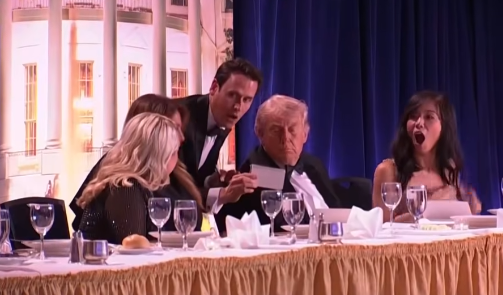
The incident unfolded on the evening of April 25, 2026, during one of the most high-profile gatherings in Washington, D.C. The Correspondents’ Dinner is known for bringing together journalists, political leaders, celebrities, and policymakers in a rare setting that blends humor, tradition, and political symbolism. Security at the event is typically extensive, especially when a current or former president is in attendance.
According to early reports, the situation began outside the main ballroom area, near a secured checkpoint. A man approached the perimeter in a manner that raised immediate concern among security personnel. Within moments, a confrontation escalated, and shots were fired. The exact sequence—who fired first, and under what conditions—remains under investigation, but what is clear is that the response from security forces was immediate.
Agents from the United States Secret Service, along with local law enforcement, moved quickly to neutralize the threat. The suspect was subdued and taken into custody at the scene before gaining access to the main event space. This rapid response likely prevented a far more dangerous situation from unfolding.
Inside the venue, confusion spread quickly. Attendees reported hearing what sounded like loud pops, followed by a sudden shift in the room’s energy. Within seconds, trained personnel began guiding guests to safety. Some were escorted out through secure exits, while others were instructed to shelter in place as authorities assessed the situation.
Trump, who was present at the event, was swiftly evacuated as part of standard protective protocol. At no point, according to officials, was he directly exposed to the shooter. He was later confirmed to be unharmed, and subsequent statements emphasized that the security system functioned as intended under pressure.
One detail that has emerged is that at least one law enforcement officer was struck during the incident. Fortunately, the officer was wearing protective gear, which prevented life-threatening injury. This has been cited as a reminder of both the risks involved in these situations and the importance of preparedness.
As news of the shooting spread, social media quickly filled with dramatic claims. Some posts described the incident as a “direct assassination attempt,” while others suggested multiple attackers or a coordinated plot. However, officials have so far indicated that the suspect appears to have acted alone. Investigators are working to determine motive, background, and whether there were any warning signs leading up to the event.
This gap between verified facts and online speculation highlights a recurring issue in modern news cycles. In the absence of complete information, narratives tend to fill the void—often in exaggerated or misleading ways. The phrase “shots fired” alone can trigger a wide range of interpretations, many of which go far beyond what actually occurred.
In reality, while the situation was serious, it was also contained. The suspect did not breach the inner security perimeter. The president was not injured. The event, though disrupted, did not turn into the large-scale tragedy that early rumors hinted at.
Still, the incident raises important questions.
How did an armed individual get close enough to a high-security event to discharge a weapon? Were there lapses in screening procedures, or was this a case of someone exploiting a narrow vulnerability? These are the kinds of issues that security agencies will be examining closely in the coming days.
The Correspondents’ Dinner has long been a symbol of the relationship between the press and the presidency. It’s a rare moment where political tension is set aside—at least publicly—in favor of humor and reflection. An event like this being interrupted by violence, even briefly, underscores how fragile that sense of normalcy can be.
Trump himself later addressed the incident, expressing gratitude to the Secret Service and law enforcement for their swift action. He also emphasized the need for continued vigilance, noting that public figures remain potential targets in a highly polarized environment.
Beyond the political implications, there’s a broader societal context to consider. Incidents involving gunfire in high-profile settings tend to resonate far beyond the immediate scene. They feed into ongoing debates about security, public safety, and the tone of political discourse in the United States.
At the same time, it’s important not to let speculation outpace evidence. Investigations like this take time. Authorities will review surveillance footage, interview witnesses, and analyze the suspect’s background before drawing conclusions. Jumping ahead of that process can lead to misinformation—and unnecessary fear.
For now, the confirmed facts remain clear:
Shots were fired near the event.
A suspect was apprehended quickly.
Donald Trump was safely evacuated and unharmed.
Everything beyond that is still being pieced together.
Moments like this often become defining headlines, but their true significance lies in what follows. Will there be changes to how high-profile events are secured? Will the incident influence public perception of safety in political spaces? And perhaps most importantly, how will information about events like this be shared and understood in an era where speed often outweighs accuracy?
In the end, the story is not just about what happened in those tense moments outside the ballroom. It’s also about how institutions responded, how information spread, and how a potentially dangerous situation was brought under control before it escalated further.
And for now, that outcome—swift containment, no loss of life, and a suspect in custody—is what defines the event.