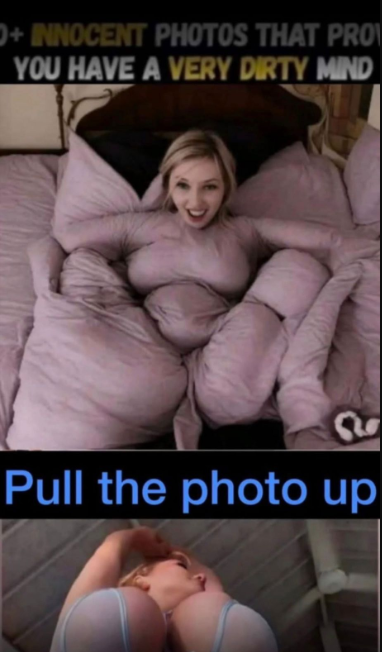
Some photos don’t reveal themselves all at once. At first glance, they seem ordinary—maybe even boring. But give them a second look, and suddenly something shifts. A hidden detail appears, perspective flips, or your brain realizes it completely misunderstood what it was seeing. That’s the magic behind images that “need a second look.” They play with perception, timing, and coincidence in ways that feel almost like visual puzzles.
Take a classic example often associated with ambiguous imagery like My Wife and My Mother-in-Law. At first, you might see a young woman looking away. Then, almost magically, the same lines rearrange in your mind and you see an older woman’s face. Nothing in the image changes—only your interpretation does. That’s the core trick behind many of these photos: your brain fills in gaps based on assumptions, and sometimes it guesses wrong.
Another famous illusion, similar in how it challenges perception, is Rubin Vase. Is it a vase, or two faces staring at each other? You can’t see both at once, which makes it fascinating. Photos that need a second look often work the same way—they force your brain to “choose” what it’s seeing, then surprise you with an alternative.
Now imagine a picture of a dog running through a field. Nothing unusual, right? But then you notice the dog seems to have two heads. Look closer, and you realize it’s actually two dogs perfectly aligned at just the right moment. Timing like this is everything. Photographers—whether professional or just lucky—capture split seconds where reality looks distorted or surreal.
Perspective is another powerful trick. Picture someone “holding up” a giant landmark in the distance, like the Leaning Tower of Pisa. Tourists do this all the time, using forced perspective to create the illusion that they’re interacting with something much larger or farther away. In more accidental photos, though, perspective can create confusing overlaps—like a person appearing to have an extra limb because someone else is standing directly behind them.
Shadows also play a huge role in deceptive images. A shadow can stretch, bend, or merge with other shapes, creating forms that don’t match the object casting them. Imagine a simple streetlight casting a shadow that looks eerily like a human figure, or a person’s shadow that seems to have horns or wings. Your brain tries to make sense of it, often jumping to conclusions before you realize it’s just light playing tricks.
Reflections are another category entirely. A photo taken through glass might show both what’s behind the camera and what’s in front of it, layered together in a confusing way. A city skyline reflected in a window can blend with an indoor scene, making it look like objects are floating in midair. Sometimes people appear to be in two places at once because of mirrors or reflective surfaces, creating images that feel almost supernatural.
Animals are frequent stars of these “second look” pictures. A cat curled up in a strange position might look like a completely different creature at first glance. A horse caught mid-motion might appear to have extra legs. These aren’t edits—they’re just perfect timing combined with unusual angles. Nature doesn’t follow our expectations, and when a camera freezes a moment, it can look bizarre.
Then there are photos where color and patterns trick your eyes. Striped clothing can blend into backgrounds, making parts of a person seem invisible. Camouflage—whether intentional or accidental—can hide objects in plain sight. Sometimes you’ll stare at a picture for several seconds before finally spotting the hidden animal or object that was there the whole time.
Urban environments are especially rich with these illusions. Buildings, signs, and advertisements overlap in ways that create unintended humor or confusion. A billboard might line up perfectly with a passerby’s body, making it look like they’re wearing something outrageous. Or a street sign might appear to grow out of someone’s head due to the angle of the shot.
Some images are funny once you figure them out. Others are slightly unsettling. A hallway that looks normal at first might reveal an impossible shape when you study it more closely. A staircase might seem to go in two directions at once, echoing the impossible architecture seen in works like those by M. C. Escher. While his art was intentionally designed to confuse, real-life photos sometimes stumble into similar visual paradoxes by accident.
What makes all these images so compelling is how they expose the shortcuts your brain takes. You don’t analyze every pixel of what you see—instead, your mind quickly builds a story based on past experience. Most of the time, that works perfectly. But in these photos, those shortcuts lead you astray, and the correction is what creates that satisfying “aha” moment.
There’s also a social element to these pictures. People love sharing them, challenging others to “look again” or “spot what’s wrong.” It turns a simple image into a kind of game. And because everyone’s perception is slightly different, two people might notice different things first, making the experience even more interesting.
In the end, photos that need a second look remind us that seeing isn’t always understanding. The world is full of moments that, when frozen in time, don’t behave the way we expect. Whether it’s a trick of light, a coincidence of timing, or a clever angle, these images invite us to slow down and question what we think we’re seeing.
And maybe that’s why they’re so addictive. In a fast-moving world, they force you to pause—even if just for a few seconds—and look again.