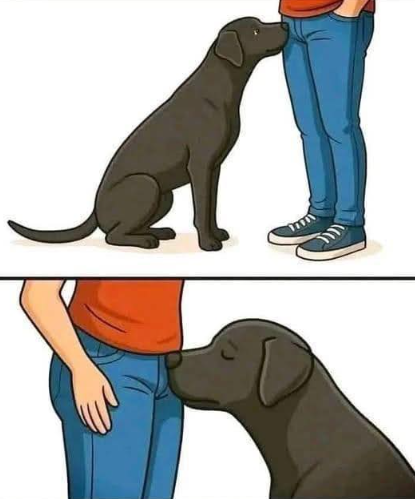
That viral claim is misleading. When a dog sniffs your “private parts,” it’s not because of anything scandalous—it’s because of how dogs understand the world.
Dogs rely heavily on their sense of smell, a system tied to a specialized organ called the Vomeronasal organ. This allows them to detect chemical signals—often referred to as Pheromones—that humans don’t consciously notice. These signals are naturally stronger in areas where sweat glands are concentrated, including the groin region.
From a dog’s perspective, it’s simply gathering information.
Think about how humans might shake hands or make eye contact when meeting someone new. Dogs don’t rely on vision the same way—we’re actually not that visually expressive to them compared to scent. So instead, they “introduce themselves” by sniffing. And yes, sometimes that means heading straight for areas that feel awkward to us.
There are a few specific reasons this behavior happens:
1. Scent concentration
The human body produces different odors across different areas, and the groin region tends to have a higher concentration of scent due to sweat glands. For a dog, that’s like reading a detailed profile—it can pick up information about identity, mood, and even subtle biological changes.
2. Curiosity and recognition
Dogs use smell to recognize individuals. If you’re new to a dog, or if it hasn’t seen you in a while, it may sniff more intensely as a way of “checking in” and confirming who you are.
3. Changes in your body
Dogs can sometimes detect changes in hormones, which is why people occasionally claim dogs behave differently around pregnancy, illness, or stress. While dogs are sensitive to changes in scent, it doesn’t mean they’re making the kinds of conclusions people often jump to online.
4. Learned behavior
If a dog has done this before and hasn’t been corrected, it may simply continue because it sees it as normal behavior. Dogs don’t have a built-in sense of human social boundaries—they learn them over time.
It’s important to be clear about what this behavior does not mean.
It does not indicate anything inappropriate about you.
It does not mean a dog is detecting something “wrong” with your body.
And it certainly doesn’t support the kind of sensational or misleading claims you might see in clickbait posts.
Those viral posts are designed to grab attention, not to inform.
If the behavior bothers you, it’s okay to redirect it. You can gently step back, turn your body away, or give the dog a simple command like “sit.” Most dogs can be trained to greet people more politely with consistency.
Understanding why dogs behave this way helps take the awkwardness out of the situation. What feels embarrassing to us is completely neutral to them—it’s just part of how they explore and understand the world.
So the next time it happens, instead of worrying about what it “means,” it’s more accurate to think: your dog is just using its strongest sense to gather information—nothing more, nothing less.