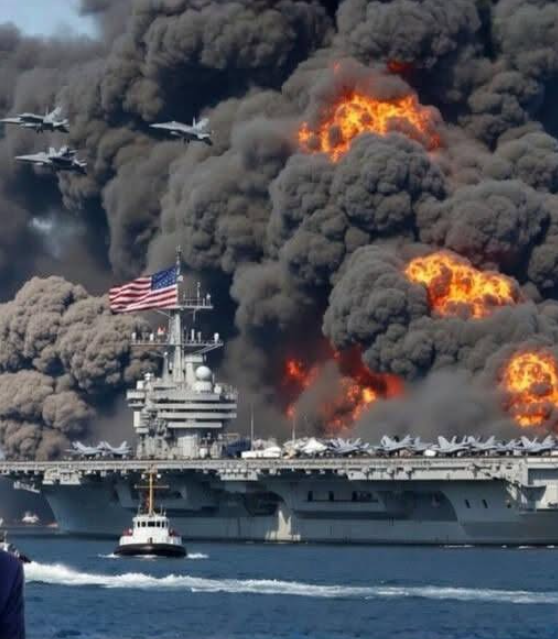
Claims like “a Russian Su-57 pilot destroyed a U.S. aircraft carrier carrying 700 tanks” are designed to grab attention—but they fall apart quickly when you look at how modern militaries and naval operations actually work. Stories framed this way often spread rapidly on social media because they combine dramatic imagery with geopolitical tension, but they rarely reflect reality.
To begin with, the Sukhoi Su-57 is indeed one of Russia’s most advanced fighter aircraft. It is designed for air superiority, stealth operations, and precision strikes. However, even advanced fighter jets are not equipped to single-handedly destroy a U.S. aircraft carrier. Carriers are among the most heavily defended and resilient military assets in the world, surrounded by layered protection systems including escort ships, submarines, radar systems, and advanced missile defenses.
A U.S. aircraft carrier, such as the USS Gerald R. Ford, is not just a ship—it is the centerpiece of an entire carrier strike group. This group typically includes guided-missile destroyers, cruisers, submarines, and supply ships, all working together to detect and neutralize threats long before they get close. Any hostile aircraft attempting to approach would likely be detected hundreds of miles away and intercepted by fighter jets launched from the carrier itself.
Another major flaw in the claim is the idea that an aircraft carrier would be “carrying 700 tanks.” Aircraft carriers are designed to transport and launch aircraft, not heavy ground vehicles. Tanks are typically transported on amphibious assault ships or cargo vessels, not on carriers. Even then, the number “700 tanks” is wildly unrealistic—such a quantity would exceed the capacity of multiple large transport ships combined.
The logistics alone make the scenario implausible. Modern tanks like the M1 Abrams weigh around 60–70 tons each. Transporting hundreds of them would require a massive fleet of specialized ships, not a single carrier. Military operations are highly structured, and equipment is distributed based on mission needs, not concentrated in ways that create a single point of catastrophic failure.
There is also the question of escalation. An attack by a Russian military aircraft on a U.S. carrier would constitute a direct act of war between two nuclear-armed powers. Such an event would immediately dominate global headlines, trigger emergency responses from governments worldwide, and likely lead to rapid military escalation. You would see confirmation from multiple credible sources, including official statements, international organizations, and major news outlets. The absence of such confirmation is a strong indicator that the claim is false or fabricated.
Misinformation like this often spreads during periods of heightened geopolitical tension. It plays on fears and uncertainties, making it more likely for people to share without verifying. In some cases, these stories are intentionally created as propaganda or disinformation, aiming to influence public perception or create panic.
It’s important to approach such claims critically. Ask basic questions: Does the scenario make logistical sense? Are there credible sources reporting it? Does it align with known capabilities of the technology involved? In this case, the answer to all of those questions is no.
That said, the broader context—tensions between major powers, advancements in military technology, and the risks of conflict—is very real. Countries continue to invest heavily in next-generation weapons systems, including stealth aircraft, hypersonic missiles, and cyber warfare capabilities. These developments do increase the complexity and potential خطر of modern conflicts, even if sensational claims like this one are not true.
In conclusion, the story of a Russian Su-57 destroying a U.S. aircraft carrier carrying 700 tanks is not credible. It contradicts basic facts about military hardware, logistics, and strategy. Rather than reflecting an actual event, it serves as an example of how easily misinformation can spread and how important it is to verify dramatic claims before accepting them as truth.