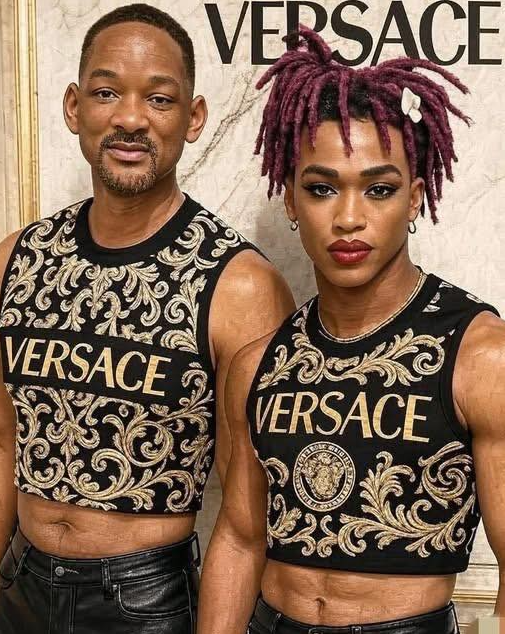
The relationship between Will Smith and his son Jaden Smith has become one of the most talked-about examples of how masculinity is evolving in real time. Not because they set out to lead a movement, but because they’ve consistently shown a willingness to step outside traditional expectations—especially in an industry that has long rewarded conformity.
For decades, masculinity—particularly in Hollywood—was defined by a narrow set of traits: toughness, emotional restraint, dominance, and a certain visual image. Men were expected to be strong, silent, and unshakable. Vulnerability was often framed as weakness, and self-expression was limited to what fit within those boundaries.
But the dynamic between Will and Jaden tells a different story.
Will Smith, who built his career on charisma, confidence, and a larger-than-life persona, represents a bridge between eras. Early in his career, he embodied many of those traditional traits—action star, leading man, the guy who saves the day. Yet over time, he began to publicly explore a more nuanced version of himself. Through interviews, social media, and personal reflections, he opened up about fear, failure, relationships, and emotional growth.
That shift alone was significant.
But then came Jaden.
From a young age, Jaden Smith made it clear he wasn’t interested in fitting into predefined boxes. Whether it was his fashion choices, his philosophical tweets, or his artistic projects, he consistently challenged the idea that masculinity has to look or feel a certain way. He wore skirts in major campaigns, spoke openly about identity and individuality, and rejected the pressure to conform.
For some, it was confusing. For others, it was refreshing.
And that’s where the real impact lies—not in universal approval, but in the conversations it sparked.
What makes their relationship especially compelling is the support between them. Will didn’t shut Jaden down or force him into a more “acceptable” mold. Instead, he often expressed admiration for his son’s fearlessness. That kind of support sends a powerful message: masculinity doesn’t have to be rigid, and fathers don’t have to enforce outdated norms to raise strong sons.
In fact, strength itself is being redefined.
In this new context, strength includes emotional awareness, authenticity, and the courage to be different. It’s not about suppressing feelings—it’s about understanding and expressing them. It’s not about dominance—it’s about confidence without insecurity.
Jaden’s approach to masculinity leans heavily into self-expression. He treats identity as something fluid, something to explore rather than defend. His style choices—often blending traditionally masculine and feminine elements—challenge the idea that clothing has a gender. And by doing so publicly, he creates space for others to question their own assumptions.
Will, on the other hand, represents growth.
He didn’t start in this space, but he moved toward it. That journey is just as important, because it shows that redefining masculinity isn’t limited to one generation. It’s something that can evolve over time. His willingness to learn from his children, to admit when he doesn’t have all the answers, and to embrace vulnerability adds depth to the conversation.
Together, they create a kind of dialogue.
It’s not always smooth. There have been moments of tension, differences in perspective, and public scrutiny. But that’s part of the process. Redefining something as deeply ingrained as masculinity isn’t supposed to be easy or universally accepted.
And the public reaction reflects that.
Some people see their approach as progressive and necessary—a move toward a more inclusive, emotionally healthy definition of manhood. Others view it as confusing or even threatening to traditional values. That divide highlights just how powerful these cultural shifts can be.
But regardless of where people stand, it’s hard to ignore the influence.
Young men growing up today are exposed to a wider range of possibilities than previous generations. They can be expressive, sensitive, creative, bold, and unconventional—all without having to sacrifice their identity as men. That doesn’t mean traditional masculinity disappears; it means it’s no longer the only option.
And that’s the key difference.
Redefining masculinity isn’t about replacing one rigid standard with another. It’s about expanding the definition so that it includes more ways of being. It allows for individuality instead of enforcing uniformity.
The impact goes beyond fashion or public statements. It touches on mental health, relationships, and self-worth. When men feel allowed to express emotions without judgment, they’re more likely to seek help, build deeper connections, and develop a stronger sense of self.
In that sense, what Will and Jaden represent isn’t just a celebrity narrative—it’s part of a broader cultural shift.
They’re not the only ones contributing to it, but their visibility amplifies the message. When well-known figures challenge norms, it creates ripple effects. Conversations start. Perspectives shift. Slowly, expectations begin to change.
And maybe that’s what redefining masculinity really looks like—not a single moment or statement, but an ongoing process. A series of choices, conversations, and examples that gradually reshape how we understand identity.
Will Smith and Jaden Smith didn’t rewrite the definition overnight. But by living authentically, supporting each other, and refusing to be confined by outdated ideas, they’ve helped move the conversation forward.
And in doing so, they’ve shown that masculinity isn’t something you have to fit into.
It’s something you can define for yourself.