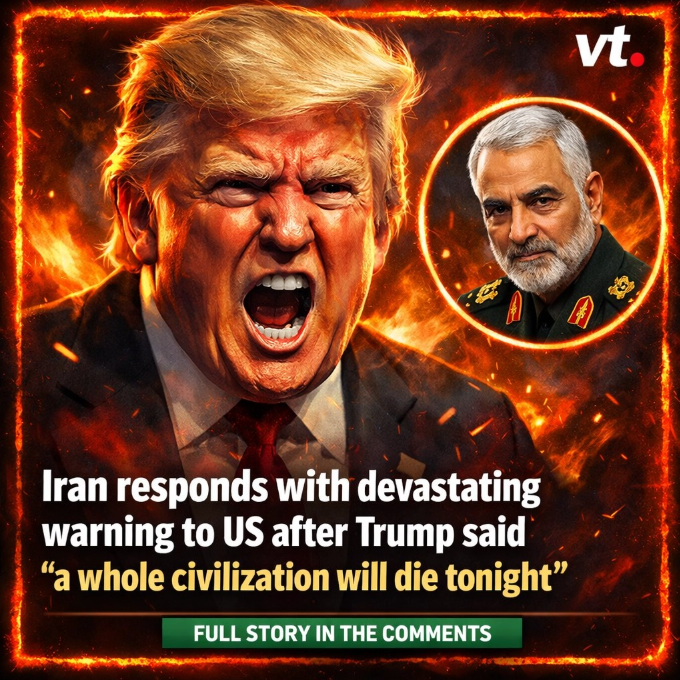
The latest confrontation between Donald Trump and Iran has triggered one of the most intense rhetorical clashes in recent geopolitical history. At the center of it is Trump’s stark warning that “a whole civilization will die tonight” if Iran failed to meet his deadline—language that immediately drew a fierce and defiant response from Tehran and sent shockwaves across the world.
The Warning That Shook the World
Trump’s statement was issued as part of a high-stakes ultimatum tied to ongoing conflict and negotiations. He demanded that Iran reopen the strategically vital Strait of Hormuz—a narrow waterway through which a significant portion of the world’s oil supply passes. If Iran refused, Trump threatened massive strikes targeting infrastructure across the country.
His words were unusually apocalyptic, even by the standards of heated international diplomacy. He warned that an entire civilization—referring to Iran’s long-standing cultural and historical identity—could be wiped out in a single night.
The statement came amid escalating U.S. military actions, including strikes on key sites such as transport infrastructure and energy-related facilities.
Iran’s Immediate and Scathing Response
Iran did not respond with submission—instead, it answered with defiance, warnings, and mobilization.
Officials within Iran’s leadership signaled that they would not accept ultimatums under threat. The government rejected the U.S. proposal outright and cut off direct communications at one point, indicating a sharp deterioration in diplomatic channels.
Even more striking was the tone of Iran’s military and political messaging. The Islamic Revolutionary Guard Corps warned that any large-scale U.S. attack would be met with severe retaliation—not just against American forces, but also against U.S. allies in the region.
One statement suggested that Iran would target energy infrastructure across the Gulf, potentially depriving the region—and by extension, parts of the global economy—of oil and gas for years.
This was not just rhetoric. Reports indicated that Iranian forces had already begun retaliatory actions, including strikes on regional energy facilities and maritime targets.
A Nation Mobilizes
Inside Iran, the response extended beyond official statements. Leaders called on civilians to prepare for potential conflict in dramatic ways.
Some officials urged citizens to form human chains around critical infrastructure such as power plants, signaling both a defensive posture and a symbolic show of unity.
There were also claims that millions of people volunteered in response to calls for national mobilization, reflecting how seriously the threat was being taken domestically.
This blending of civilian and military response underscored the depth of the crisis. It was not just a confrontation between governments—it was rapidly becoming a moment of national identity and survival for many Iranians.
Global Alarm and Legal Concerns
Trump’s warning did not just provoke Iran—it alarmed much of the international community.
Legal experts and policymakers quickly pointed out that targeting civilian infrastructure such as power plants and water systems could violate international law and potentially constitute war crimes.
Allies and critics alike expressed concern that the rhetoric—and the potential actions behind it—could trigger a broader regional war or even a global economic crisis. The Strait of Hormuz is too critical to global energy markets for any disruption to go unnoticed.
Markets reportedly hesitated, and governments around the world monitored the situation closely, unsure whether Trump’s threat would be carried out or was a negotiating tactic.
A Brink-of-War Moment
As the deadline approached, the world entered what many described as a tense countdown. Military activity intensified, rhetoric escalated, and uncertainty dominated headlines.
Some analysts interpreted Trump’s language as part of a high-risk negotiation strategy—sometimes described as “madman theory” diplomacy—where extreme threats are used to force concessions.
Others feared it was more than strategy—that it represented a genuine willingness to escalate to unprecedented levels of destruction.
The Unexpected Twist
In a dramatic turn of events, the crisis did not culminate in immediate catastrophe. Instead, a last-minute diplomatic effort led to a temporary breakthrough.
A conditional ceasefire agreement was reached just hours before the deadline, reportedly involving mediation efforts and concessions related to the Strait of Hormuz.
This sudden de-escalation stunned observers. After hours of brinkmanship and global anxiety, the immediate threat of widespread destruction was pulled back.
What It All Means
The episode reveals several key realities about modern geopolitics.
First, rhetoric matters. Words from powerful leaders can move markets, mobilize populations, and bring the world to the edge of conflict within hours.
Second, the U.S.–Iran relationship remains one of the most volatile fault lines in international relations. Even small triggers can escalate rapidly when trust is low and stakes are high.
Third, the incident highlights the blurred line between strategy and danger. While aggressive threats may sometimes yield short-term concessions, they also risk unintended consequences—miscalculation, retaliation, or escalation beyond control.
Final Thoughts
Iran’s “scathing response” was not just about rejecting a demand—it was about asserting sovereignty, signaling readiness for retaliation, and rallying a nation under threat. At the same time, Trump’s warning demonstrated how quickly political messaging can escalate into existential language with global implications.
In the end, the world stepped back from the brink—this time. But the episode leaves behind a lingering question: how many more times can such high-stakes brinkmanship occur before a crisis doesn’t end with a last-minute deal?