Have you ever looked at a photograph and felt your brain hesitate for just a second, unsure of what it was seeing? Those are the kinds of images that demand a second glance, the ones that challenge perception and make you question reality. They are not necessarily edited or manipulated in complex ways. Instead, they rely on timing, angles, lighting, and coincidence to create confusion. These bizarre photos are fascinating because they reveal how easily our minds can be tricked.
Human perception is not perfect. Our brains are constantly trying to make sense of the world by filling in gaps, making assumptions, and interpreting visual cues based on past experiences. Most of the time, this system works flawlessly. However, when something disrupts those expectations, even slightly, the result can be disorienting. That is why certain photographs appear strange at first glance. They exploit the shortcuts our brains use to process visual information quickly.
One of the most common ways photos create confusion is through perspective. When a camera captures a scene from a particular angle, it can distort the relationship between objects. A person standing far away might appear tiny, while someone closer to the camera seems enormous. This trick becomes even more effective when the two subjects are aligned in a way that makes them appear to interact. For example, someone might look like they are holding a distant building in their hand or balancing a massive object on their shoulder. In reality, it is simply a matter of distance and alignment, but the illusion feels convincing.
Perspective illusions are especially popular in travel photography. People often take photos where they appear to push, hold, or interact with famous landmarks. These images are playful, but they also demonstrate how easily our sense of scale can be manipulated. The brain relies heavily on context to determine size, and when that context is removed or altered, the result can be surprising.
Timing is another powerful factor in creating confusing images. A photograph captures a single moment in time, and sometimes that moment is just unusual enough to look unreal. A jumping animal might appear to float in midair, frozen in a position that seems impossible. A person caught mid-motion might look distorted or elongated. Objects can align perfectly for a fraction of a second, creating visual combinations that never exist outside that instant.
Perfectly timed photos often feel like accidents, but they are part of what makes photography so compelling. They capture moments that the human eye might not fully register in real time. When we see them later, our brains struggle to reconcile what appears to be happening with what we know is possible. This tension creates curiosity and amusement.
Shadows also play a significant role in visual confusion. They can stretch, distort, and transform ordinary objects into something entirely different. A simple object can cast a shadow that looks like a completely unrelated shape. For instance, a signpost might cast a shadow that resembles a human figure, or a person’s shadow might appear to have exaggerated features that do not match their actual body.
What makes shadow illusions particularly interesting is that they create a dual image. There is the object itself and the shadow it produces, and when those two do not align in an obvious way, the brain tries to make sense of both at once. This can lead to amusing or even eerie interpretations.
Reflections are another source of visual trickery. Mirrors, windows, and water surfaces can create layered images that blend multiple scenes together. A reflection might show something that is not visible in the main frame, leading to confusion about what is real and what is not. In some cases, reflections can create the illusion of transparency, making solid objects appear as though they are see-through.
Water reflections are especially striking because they can invert an image perfectly. A building reflected in a puddle might look like it is standing upside down in the sky. When the reflection is clear and the surrounding context is minimal, it can be difficult to tell which way is up. This challenges our sense of orientation and forces us to reevaluate what we are seeing.
Camouflage and blending also contribute to confusing photographs. Sometimes, objects or animals blend so seamlessly into their surroundings that they become nearly invisible. This can happen naturally, as with animals that have evolved to match their environment, or accidentally, when colors and patterns align in unexpected ways. A dog lying on a patterned rug might be difficult to spot, or an object placed against a similarly colored background might disappear from view.
These images often turn into visual puzzles. The viewer is invited to search for the hidden subject, and the satisfaction of finally spotting it adds to the appeal. It is a reminder that not everything is immediately obvious and that careful observation can reveal details that are easy to miss.
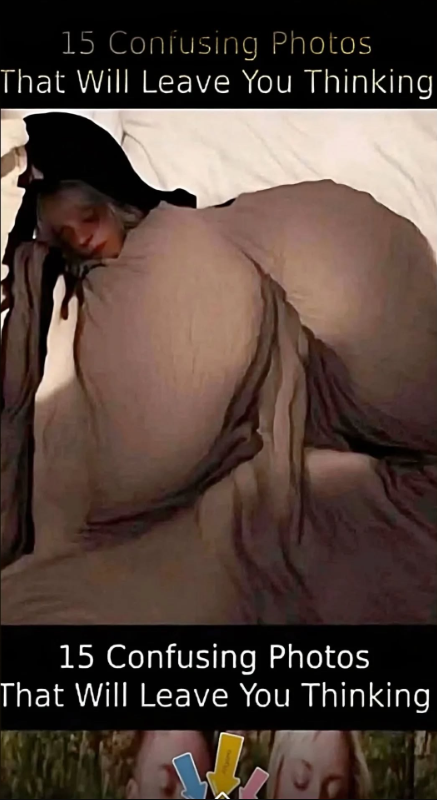
Human bodies can also become the source of strange illusions. When people overlap or position themselves in certain ways, their forms can merge into something that looks unnatural. A person might appear to have extra limbs, no legs, or an oddly shaped torso. These illusions are particularly striking because we are so familiar with the human form. When something looks even slightly off, it captures our attention immediately.
Clothing and accessories can enhance these effects. Patterns, colors, and textures can blend together, making it difficult to distinguish where one person ends and another begins. This can create humorous or confusing images that take a moment to understand.
Another factor that contributes to bizarre photos is depth of field. Cameras can focus on a specific part of an image while blurring the background or foreground. This selective focus can create a sense of separation between objects, but it can also lead to confusion when important details are out of focus. A blurred object might look like something entirely different, depending on its shape and position.
Lighting is equally important. The way light falls on a subject can highlight certain features while obscuring others. Strong contrasts between light and shadow can create dramatic effects that alter the appearance of objects. In some cases, lighting can flatten a scene, making it difficult to judge depth and distance. In others, it can exaggerate textures and shapes, leading to unusual interpretations.
Color also plays a role in how we perceive images. Certain color combinations can create optical illusions, making objects appear to move, vibrate, or change shape. When colors blend or clash in unexpected ways, they can confuse the eye and make it harder to distinguish between different elements in a photo.
What makes all of these effects so compelling is that they reveal the limits of human perception. We like to think that we see the world as it truly is, but in reality, our brains are constantly interpreting and simplifying the information we receive. When a photograph disrupts that process, it exposes the assumptions we rely on without even realizing it.
There is also a sense of playfulness in these images. They invite us to engage with them, to look closer, and to figure out what is happening. This interaction makes them more memorable than ordinary photos. Instead of passively viewing an image, we become active participants in decoding it.
In a world where images are everywhere, it can be easy to scroll past them without giving them much thought. However, photos that require a double take stand out because they break that pattern. They slow us down and encourage us to pay attention. They remind us that there is more to see than what appears at first glance.
These kinds of images are also widely shared because they spark curiosity and conversation. People enjoy showing them to others and asking, “What do you see?” The variety of interpretations can lead to interesting discussions about perception and perspective. It becomes clear that different people can see the same image in different ways, depending on how their brains process the information.
This subjectivity is part of what makes visual illusions so fascinating. They highlight the fact that reality is not always as straightforward as it seems. Our understanding of the world is shaped by our experiences, expectations, and cognitive processes. When those factors are challenged, it creates a moment of surprise that can be both amusing and thought-provoking.
Ultimately, bizarre photos from confusing perspectives remind us to question what we see. They encourage us to look beyond the obvious and consider alternative explanations. They show us that even something as seemingly simple as a photograph can hold layers of complexity.
The next time you encounter an image that does not make sense right away, take a moment to study it. Look at the details, consider the angles, and think about how it might have been captured. You might find that the explanation is simple, but the experience of figuring it out is what makes it enjoyable.
In the end, these photos are more than just visual tricks. They are a celebration of curiosity, creativity, and the fascinating ways in which our minds interpret the world