At Dover Air Force Base, one of the most solemn traditions in American military life unfolds in quiet dignity. The return of fallen service members—known as a “dignified transfer”—is a moment that transcends politics, headlines, and public debate. It is a sacred ritual rooted in honor, sacrifice, and national gratitude. When Donald Trump traveled to the base to pay respects to fallen U.S. soldiers, the occasion carried profound emotional weight for families, military personnel, and the country as a whole.
The ceremony begins long before the aircraft touches down. Military personnel prepare meticulously, ensuring every detail reflects the gravity of the moment. The plane, often arriving under the cover of night or early dawn, carries flag-draped transfer cases—each representing a life given in service to the nation. Silence fills the airfield, broken only by the low hum of engines and the crisp commands of the honor guard.
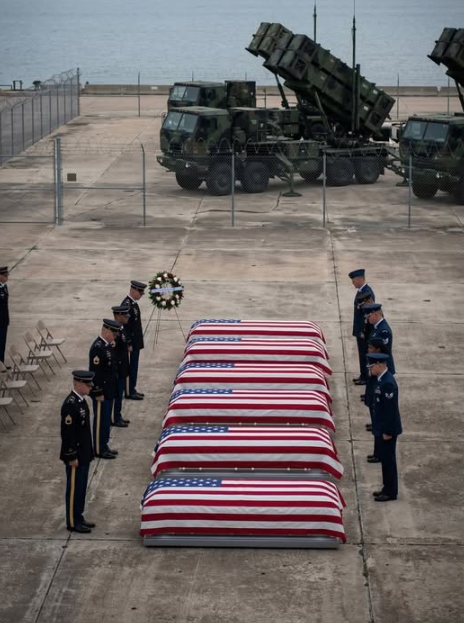
As the aircraft doors open, a team of uniformed service members, dressed in immaculate ceremonial attire, steps forward. Their movements are deliberate, synchronized, and precise. Each transfer case is carefully carried down the ramp, never rushed, never casual. The American flag, folded with exacting care, drapes each case, symbolizing both the nation’s gratitude and its grief.
During President Trump’s visit, he stood alongside military leaders and grieving families, observing the ceremony with visible solemnity. Though often known for his outspoken public persona, moments like these reveal a quieter, more reflective side of leadership. With hand over heart or raised in salute, he honored each fallen service member individually as their remains were transferred from the aircraft.
For the families present, the experience is both heartbreaking and deeply meaningful. Many have traveled from across the country to witness the return of their loved ones. In these moments, the presence of the president—regardless of political affiliation—serves as a symbol of national recognition. It is a reminder that their sacrifice is not unseen, that their loss is shared by the country they served.
The dignified transfer is not a spectacle for public consumption. In fact, media access is often limited, and coverage is handled with sensitivity and respect. Families are given privacy to grieve, while the military ensures that every aspect of the ceremony honors the fallen with the utmost care. This balance between public acknowledgment and private mourning reflects the deeply personal nature of military loss.
Trump’s attendance at Dover Air Force Base followed a long-standing tradition among U.S. presidents. Leaders from both parties have made the journey to Dover to pay their respects, recognizing the importance of bearing witness to the human cost of military service. These visits are not about policy or politics—they are about presence, about standing with families in their darkest hours.
In his remarks following the ceremony, Trump expressed condolences to the families and reaffirmed the nation’s commitment to honoring its service members. He spoke of courage, duty, and sacrifice—words often repeated in such settings, yet never losing their significance. For the families, hearing these words directly from the commander-in-chief can offer a measure of comfort, even amid profound grief.
The ceremony also highlights the discipline and professionalism of the U.S. military. Every salute, every step, every gesture is performed with precision, reflecting a culture that values honor above all else. The service members who carry out these duties often describe it as one of the most important responsibilities of their careers. They are not just performing a task—they are representing a grateful nation.
Beyond the ceremony itself, the impact of such events resonates across the country. News of fallen soldiers returning home reminds Americans of the ongoing sacrifices made by members of the armed forces. It brings into focus the realities of military service—realities that are often distant from everyday life for many citizens.
Critics and supporters alike may view Trump’s presidency through different lenses, but moments like these tend to transcend political divides. Honoring fallen soldiers is a unifying act, one that underscores shared values of respect, gratitude, and remembrance. It is a reminder that, despite differences, there are principles that bind the nation together.
For the families, however, the ceremony is not about unity or symbolism—it is about loss. It is about a son, daughter, spouse, or parent who will not return home alive. The dignified transfer is one of the first steps in a long journey of grief, one that will continue long after the ceremony ends and the headlines fade.
As the final transfer case is carried from the aircraft and placed into a waiting vehicle, the ceremony draws to a close. The honor guard offers a final salute. The president, along with others in attendance, stands in silence. And then, slowly, the scene begins to disperse. The families leave with their loved ones, beginning the next chapter of farewell.
Dover Air Force Base remains a place of both sorrow and honor—a place where the cost of freedom is made visible. President Trump’s presence at the ceremony serves as a reminder of the responsibility carried by those in positions of leadership. It is a responsibility not only to make decisions but to bear witness to their consequences.
In the end, the dignified transfer is not about any one individual, not even the president. It is about the fallen, about their service, and about a nation’s promise to never forget their sacrifice. Each ceremony tells a story—of bravery, of duty, and of a life given in the service of others.
And in the quiet moments on the tarmac at Dover, as flags ripple gently in the wind and salutes are rendered with unwavering precision, that promise is renewed once again.