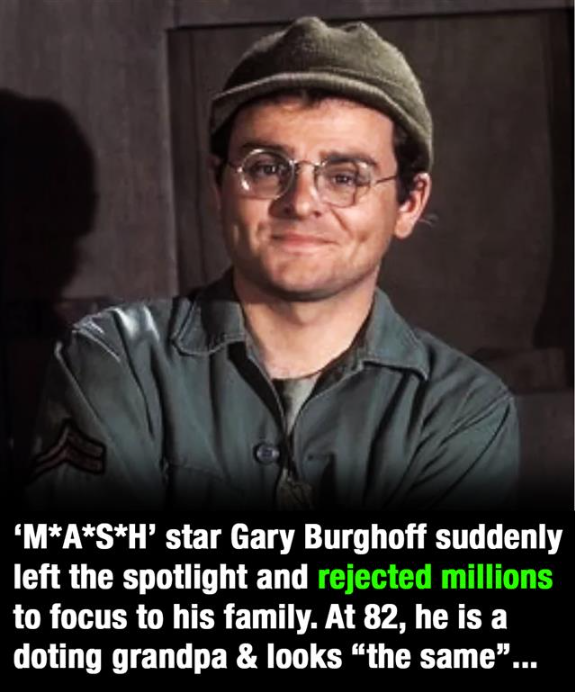
When people think of the television classic M*A*S*H, one of the first characters that comes to mind is the soft-spoken, boyish company clerk Walter “Radar” O’Reilly. Played by Gary Burghoff, Radar became an emotional anchor for audiences during the show’s early seasons. His innocence, loyalty, and uncanny ability to anticipate incoming helicopters made him both endearing and unforgettable. But behind the scenes, Burghoff made a decision that surprised many at the height of the show’s success: he chose to walk away—not for scandal, not for creative differences, but for something far more personal and meaningful—his family.
At the time, MASH* was not just popular; it was a cultural phenomenon. Airing during a period when America was still grappling with the emotional aftermath of the Vietnam War, the show managed to blend humor with heartbreak in a way few series ever had. Radar, with his wide eyes and gentle demeanor, symbolized a kind of purity in the chaos of war. For many viewers, he was the heart of the 4077th Mobile Army Surgical Hospital. So when Burghoff announced his departure in 1979, fans were stunned.
Burghoff’s exit was written into the series with a two-part episode titled “Goodbye Radar,” one of the most emotional arcs in the show’s history. Radar receives word that his uncle has died, leaving his mother alone to manage the family farm back in Iowa. The character’s decision to return home mirrors, in many ways, the real-life priorities of the actor portraying him. While the storyline provided a believable reason for Radar’s departure, it also subtly reflected Burghoff’s own longing to be present in his family’s life.
Fame, as it often does, came with a cost. Long filming hours, constant public attention, and the pressure of maintaining a beloved character began to take their toll. Burghoff had already experienced the role of Radar on stage and in the 1970 film version of MASH*, making him the only actor to carry the same character across all three formats—stage, film, and television. By the time he left the series, he had been living as Radar for nearly a decade.
But off-screen, Burghoff was a husband and father, and those roles were becoming increasingly important to him. In interviews over the years, he has spoken candidly about the strain that his career placed on his personal life. He didn’t want to be a distant father whose children only knew him through television reruns or brief visits between filming schedules. He wanted to be there—for birthdays, for quiet moments, for the everyday experiences that build lasting relationships.
In an industry where success is often measured by visibility and longevity, Burghoff’s choice was both rare and courageous. Walking away from a hit show at the peak of its popularity meant stepping back from steady income, public recognition, and future opportunities that might have come from continued exposure. Yet for him, the trade-off was clear. No amount of money or fame could replace the time lost with his children.
His decision also highlights a broader truth about the nature of success. Society often equates achievement with career milestones, wealth, or celebrity status. But Burghoff redefined success on his own terms. For him, being a present and engaged father outweighed the allure of Hollywood. It wasn’t about rejecting his career; it was about choosing what mattered most at a pivotal moment in his life.
After leaving MASH*, Burghoff didn’t disappear entirely from the public eye. He made occasional television appearances, including a brief return to the role of Radar in the short-lived spin-off AfterMASH. However, he largely stepped away from the relentless pace of Hollywood. He explored other interests, including painting and wildlife preservation, pursuits that allowed him a quieter, more balanced lifestyle.
Fans have continued to admire not only his performance as Radar but also the integrity behind his personal choices. In an era when many actors chase fame at all costs, Burghoff’s story serves as a reminder that it’s possible to step away, to prioritize family, and to find fulfillment beyond the spotlight.
There is also something fitting about the parallel between Burghoff and Radar. Both chose to leave the noise and urgency of their environment to return to something simpler, something more grounded. Radar went back to Iowa to help his mother run the family farm; Burghoff stepped away from Hollywood to nurture his role as a father. In both cases, the decision was rooted in love, responsibility, and a deep sense of what truly matters.
Over time, perspectives on work-life balance have evolved, but Burghoff’s choice remains strikingly relevant. In today’s fast-paced world, many people struggle to balance career ambitions with personal relationships. His story resonates because it reflects a universal dilemma: how to allocate our most precious resource—time. By choosing family, Burghoff offered a powerful example of setting boundaries and honoring personal values, even when it means going against expectations.
Looking back, his departure did not diminish his legacy; if anything, it enhanced it. Radar O’Reilly remains one of the most beloved characters in television history, and Burghoff’s performance continues to touch new generations of viewers discovering MASH* for the first time. His decision to leave the show has become part of that legacy, adding depth to the admiration fans feel for him.
In the end, Gary Burghoff’s story is not just about leaving a television show. It’s about choosing presence over prestige, connection over career, and family over fame. It’s a reminder that success is deeply personal and that sometimes the most meaningful roles we play are not the ones seen by millions, but the ones lived quietly, day by day, with the people who matter most.
For Burghoff, being “Radar” may have made him a star, but being a father gave his life its greatest purpose. And in a world often captivated by celebrity, that choice stands as a quiet, powerful testament to what truly endures.