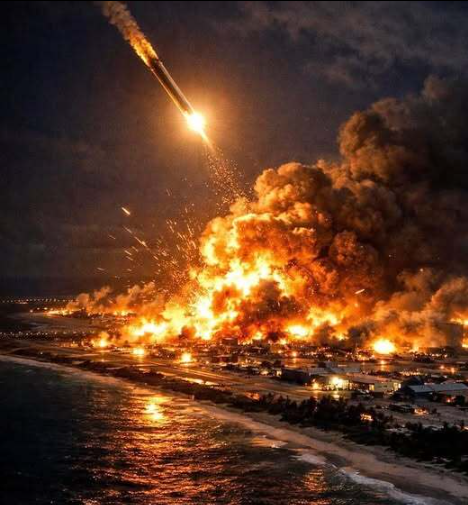
The headline sounds shocking and is designed to trigger fear, urgency, and curiosity all at once, but when you slow down and look carefully at what is actually being reported, the reality becomes much clearer and far less dramatic than it first appears. There is currently no confirmed, credible evidence that Iran has directly attacked the United States mainland. No major verified news organization has reported missiles striking American cities, no confirmed explosions have occurred on U.S. soil linked to Iran, and there is no official government confirmation of such an event. What is happening instead is a broader and highly tense military conflict that is unfolding primarily outside the borders of the United States.
The confusion comes from how modern news spreads, especially on social media platforms where headlines are often shortened, exaggerated, or stripped of context. When people read that Iran has attacked “U.S. targets,” they may immediately assume that means cities like New York, Los Angeles, or Washington, D.C. In reality, those “U.S. targets” are typically military bases, naval assets, or personnel stationed overseas, particularly in regions like the Middle East. The United States has a significant military presence in multiple countries, and those locations are often within range of Iranian missiles or allied militia forces.
In recent developments, the United States has conducted extensive military operations targeting Iranian infrastructure, including missile sites, defense systems, and strategic facilities. These strikes are part of an escalating conflict that has drawn global attention. In response, Iran has launched retaliatory actions, but these have largely been directed at U.S. military positions abroad or at regional allies. This distinction is critical, yet it is often lost in dramatic headlines that aim to capture attention rather than provide clarity.
Fear spreads quickly when people encounter phrases like “America under attack” or “Iran strikes back,” especially without context. The human brain is wired to respond to threats, and sensational wording can make distant events feel immediate and personal. However, understanding geography and military strategy helps ground the situation in reality. Direct attacks on the U.S. mainland would represent a massive escalation with severe global consequences, and such an event would be unmistakably clear, widely reported, and accompanied by emergency responses across the country.
Another factor contributing to the confusion is the presence of speculation and warnings issued by intelligence agencies. Governments often prepare for worst case scenarios, and sometimes those preparations or warnings become public. For example, discussions about potential cyberattacks or drone threats may be reported in the media, but these are not the same as actual events. They are precautionary measures, not confirmations of attacks. Unfortunately, when these warnings are taken out of context, they can easily be misinterpreted as something that has already happened.
It is also important to recognize the role of misinformation. In times of geopolitical tension, false or misleading content spreads rapidly online. Some posts are created purely for clicks, while others may be driven by political agendas or attempts to create panic. A dramatic claim like Iran hitting America can go viral within minutes, even if it is completely unverified. By the time accurate information catches up, millions of people may have already seen and reacted to the original claim.
To stay grounded, it helps to rely on a few simple checks. Look for confirmation from multiple reputable news sources. Pay attention to specific details such as location, timing, and official statements. If those details are missing or vague, that is often a sign that the information may not be reliable. Additionally, consider the scale of the claim. A direct attack on the United States would be one of the most significant global events in modern history, and it would dominate every major news outlet without exception.
The current situation between the United States and Iran is serious, but it is not accurately described by claims that America itself has been struck. It is a conflict involving military actions, strategic responses, and ongoing tensions, primarily outside U.S. borders. Understanding that distinction helps reduce unnecessary fear and allows for a clearer view of what is actually happening.
In times like these, staying informed is important, but so is staying calm and critical of the information you encounter. Not every alarming headline reflects reality, and taking a moment to question and verify what you see can make a significant difference in how you understand the world around you.