 The Story of Sylvester Stallone: From Rock Bottom to Global Icon
There are stories of struggle, and then there are stories that feel almost unbelievable—so raw, so painful, and yet so inspiring that they stay with you long after you hear them. The life of Sylvester Stallone is one of those stories.
Before the fame, before the lights of Hollywood, before the world knew his name, Stallone was just another man trying to survive in a city that had no interest in his dreams.
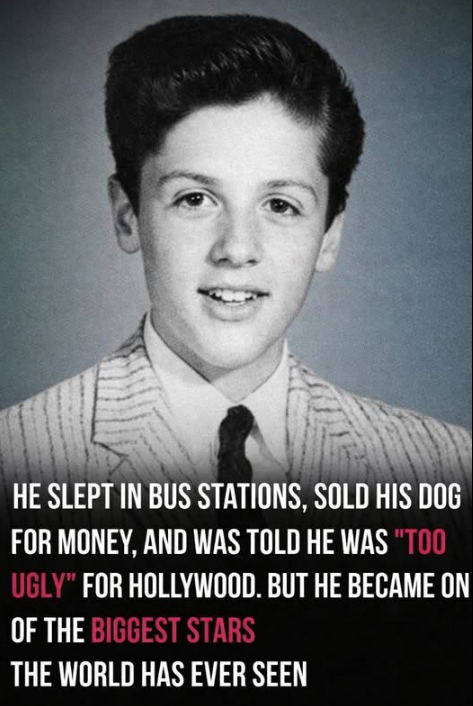
He was broke. Not struggling in the casual sense, but completely, devastatingly broke. At one point in the early 1970s, he had only a few dollars to his name. He couldn’t afford rent. He couldn’t afford food. He had nowhere to go. For several nights, he reportedly slept in a bus station in New York City, trying to stay warm and out of sight. Hunger became a constant companion, not a passing discomfort.
The lowest moment came when he faced a decision no one ever wants to make. He had a dog—his closest companion, his only consistent source of comfort during those brutal days. But desperation pushed him to a breaking point. With no money left and nothing to eat, Stallone sold his dog outside a liquor store for a small amount of cash. It wasn’t about giving up something he loved—it was about survival.
At the same time, Hollywood was shutting its doors on him. Casting agents didn’t see potential. They saw flaws. His face, shaped by a difficult birth that caused partial paralysis, gave him a slurred speech and a distinctive look. Instead of recognizing it as unique, they labeled it a problem. He was told he didn’t fit the mold. He was told he wasn’t attractive enough. He was told, in blunt terms, that he would never make it as a leading man.
Most people would have given up.
But Stallone didn’t.
One night changed everything. He watched a boxing match between Muhammad Ali and Chuck Wepner—a fight where the underdog refused to go down, pushing far beyond what anyone expected. Something clicked. That story of resilience, of refusing to quit even when defeat seemed inevitable, lit a fire inside him.
Within days, Stallone began writing a script. He poured everything into it—his frustration, his hunger, his pain, his hope. The result was a story about a small-time boxer named Rocky Balboa, a man given one unlikely shot at greatness. It wasn’t just a script; it was a reflection of his own life.
He completed it in a matter of days.
When he started pitching the script, producers were interested—but not in him. They loved the story. They saw its potential. They offered to buy it for significant money, especially considering his situation. For someone who had been sleeping in a bus station, the offers must have been incredibly tempting.
But there was a condition.
They didn’t want him to star in it.
They wanted a more traditional, more marketable actor—someone who fit Hollywood’s expectations. Someone who didn’t look or sound like Sylvester Stallone.
He refused.
Time and time again, he turned down offers that would have solved his financial problems instantly. He held onto one non-negotiable demand: he would play Rocky. To everyone else, it seemed irrational. To him, it was everything. He wasn’t just selling a script—he was fighting for his identity.
Eventually, after relentless persistence, a deal was made. The budget was small. The risk was high. But Stallone got what he wanted—he would be the lead.
Before filming began, he did something extraordinary. He went back to find the man who had bought his dog. After searching for days, he found him and begged to buy the dog back. The price had gone up significantly, but Stallone didn’t hesitate. He paid whatever he could to reunite with his companion. That moment alone speaks volumes about the kind of person he was—someone who never forgot what mattered, even after everything he had been through.
When Rocky was released in 1976, it wasn’t just a success—it was a phenomenon. Audiences connected deeply with the story. They saw themselves in Rocky’s struggle, his determination, his refusal to give up. The film went on to win the Academy Award for Best Picture, and Stallone himself was nominated for both Best Actor and Best Original Screenplay.
The same man who had been told he was “too ugly” for Hollywood was now standing at the center of it.
But the story didn’t end there.
Stallone continued to build his career, creating iconic characters and starring in films that defined entire genres. From Rocky to Rambo, he became a symbol of resilience and strength. His journey wasn’t just about success—it was about proving that rejection doesn’t define you unless you let it.
What makes his story so powerful isn’t just the outcome. It’s the path. The nights spent with nothing. The painful choices. The constant rejection. The unwavering belief in himself when no one else believed in him.
It’s easy to admire success when it’s already been achieved. It’s much harder to understand the persistence required to get there.
Sylvester Stallone’s story is a reminder that sometimes the very things the world sees as weaknesses can become your greatest strengths. His voice, his face, his style—everything that once held him back eventually set him apart.
And perhaps the most important lesson of all is this: circumstances can push you to the edge, people can doubt you, and the world can tell you no again and again—but if you refuse to give up, if you hold onto your vision no matter how impossible it seems, you can change your story.
From homelessness to global icon, from rejection to recognition, from loss to legacy—his journey proves that even in the darkest moments, there is still a path forward.