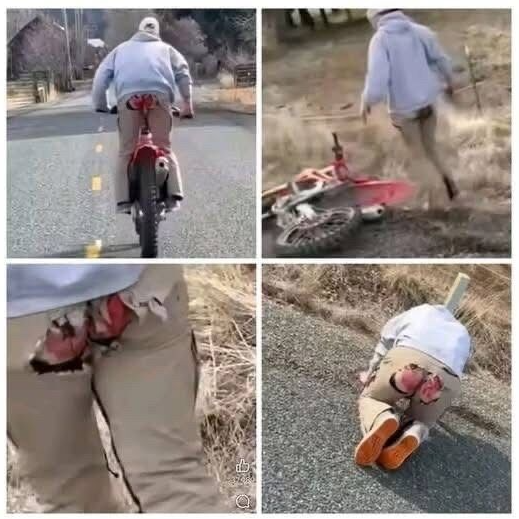
It was supposed to be a simple afternoon of practice—nothing dramatic, nothing dangerous, just a young man trying to master a skill he had dreamed about for years.
Twenty-two-year-old Daniel had always loved motorcycles. Ever since he was a kid, the sound of engines roaring down the street made him stop whatever he was doing and look. To him, motorcycles represented freedom. They represented the idea that you could leave everything behind, open the throttle, and ride toward whatever horizon you chose.
For his birthday the previous year, Daniel had finally saved enough money to buy a used motorcycle. It wasn’t flashy or expensive, but to him it was perfect. The paint had a few scratches and the engine had clearly lived a long life, yet the moment he started it for the first time, Daniel felt something he had never experienced before.
Excitement mixed with responsibility.
He knew riding a motorcycle wasn’t something to take lightly. His parents had warned him about the risks. His friends had told him stories about accidents. Even his motorcycle instructor had repeated the same advice again and again:
“Respect the machine, and it will respect you.”
Daniel listened carefully. He bought a helmet, gloves, and protective gear before he even rode his first mile. He practiced basic techniques and studied safety videos late into the night. He wanted to do everything the right way.
Still, like many beginners, confidence came slowly.
On a quiet Sunday afternoon, Daniel decided to practice again in the empty parking lot of a closed shopping center near his home. It had become his favorite training spot. The wide space gave him room to make mistakes without worrying about traffic.
He placed a few plastic cones in a line to practice weaving between them. The exercise was simple but important—it helped riders develop balance, control, and coordination.
At first, everything went well.
Daniel eased the clutch slowly, rolled forward, and carefully steered between the cones. His movements were cautious but steady. The bike responded to every shift of his weight and every twist of the throttle.
After a few laps, he started feeling more comfortable.
Maybe a little too comfortable.
He decided to increase his speed slightly to challenge himself. It seemed harmless—just a bit faster, just a bit more control.
But riding a motorcycle demands constant attention. A tiny mistake can quickly grow into a bigger one.
As Daniel approached the cones again, he accelerated a little more than before. His front wheel wobbled slightly when he turned too sharply around the second cone. Instinctively, he grabbed the brake.
Unfortunately, it was the front brake—and he squeezed it too hard.
The motorcycle reacted instantly.
The front wheel locked for a split second, the balance shifted, and the bike tilted sideways. Daniel tried to correct it, but momentum had already taken over.
In the blink of an eye, the motorcycle slid out from under him.
Daniel hit the ground hard.
The fall wasn’t violent like a highway crash, but it was enough to send a jolt of pain through his arm and shoulder. The motorcycle skidded a few feet away before coming to a stop.
For a moment, everything was silent.
Daniel lay there staring at the sky, his heart racing. The world seemed strangely quiet after the sudden chaos.
Then the pain started to register.
His elbow throbbed. His knee burned where it had scraped against the pavement. Thankfully, his helmet had protected his head.
A couple walking their dog in the distance rushed over to check on him.
“Are you okay?” the woman asked with concern.
Daniel slowly sat up, testing his arms and legs.
“I… I think so,” he said, still catching his breath.
Aside from bruises and scrapes, he seemed lucky. Very lucky.
The motorcycle had taken a small hit too—one mirror was bent and the handlebar was scratched—but it was still rideable.
The couple helped Daniel stand, and after a few minutes he began to calm down. The adrenaline faded, replaced by a mixture of embarrassment and relief.
He kept replaying the moment in his mind.
The turn.
The brake.
The loss of control.
It had happened so fast.
Daniel realized something important in that moment: learning to ride wasn’t just about excitement—it was about patience. Real patience.
Motorcycles demand humility. They demand respect for the physics of motion, balance, and reaction time.
Even experienced riders practice constantly to sharpen their skills.
Daniel thanked the couple for helping him and carefully lifted the motorcycle back upright. He checked the controls, started the engine, and listened.
It still ran smoothly.
But he didn’t continue practicing that day.
Instead, he slowly rode home, thinking about what had happened.
That small accident became one of the most important lessons of his riding journey. Not because he was injured, but because it reminded him how quickly things can change when riding on two wheels.
Over the following weeks, Daniel returned to practice—but with a different mindset.
He focused on mastering slow-speed control before trying anything faster. He practiced braking techniques carefully. He learned how to distribute weight properly during turns.
Little by little, his skills improved.
And each time he put on his helmet, he remembered that afternoon in the parking lot.
It had been a mistake.
But it was also a turning point.
Because sometimes the moments where we lose control are the ones that teach us the most about responsibility.
Daniel still rides today.
Not recklessly. Not carelessly.