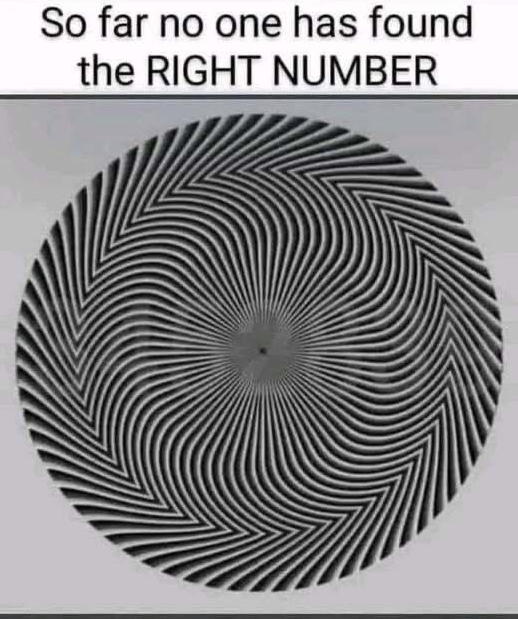
🔍 Find the Hidden Number: A Puzzle That Tricks Your Brain
Have you ever looked at an image and felt like something was hiding in plain sight? Our brains are incredible at recognizing patterns, but sometimes they can also be fooled. One popular challenge that spreads across social media and puzzle communities is the “Find the Hidden Number” puzzle. At first glance, it might look like a random collection of colors, shapes, or dots. But hidden within the image is a number that only careful observation—or a clever trick—can reveal.
These puzzles are more than simple entertainment. They play with the way our brains process visual information. The hidden number is often disguised using contrast, color gradients, overlapping patterns, or visual noise. The trick is to train your eyes and brain to look beyond the obvious and detect subtle differences.
Let’s explore how these puzzles work and how you can improve your chances of finding the hidden number.
🧠 Why Hidden Number Puzzles Are So Tricky
Our brains are designed to simplify the world around us. When we see a complex image, the brain tries to group similar colors and shapes together. This process, known in psychology as Gestalt Principles, helps us quickly understand what we’re seeing.
However, puzzle creators use this natural tendency against us.
They intentionally design images where the hidden number blends into the background. Because your brain assumes everything belongs to the same pattern, it may ignore the number completely. Only when you look carefully—or change the way you view the image—does the number suddenly appear.
It can feel almost magical when it happens. One moment you see nothing, and the next moment the number jumps out clearly.
👀 Common Techniques Used to Hide Numbers
Hidden number puzzles often rely on a few clever tricks.
1. Color Camouflage
The number might be created using colors that are only slightly different from the background. For example, a blue number hidden among slightly darker blue shapes.
Your brain initially sees everything as the same color group.
2. Visual Noise
Some puzzles cover the image with hundreds of dots or shapes. This “noise” distracts your brain from noticing the number formed underneath.
Only when you step back or blur your eyes does the pattern reveal itself.
3. Contrast Illusions
Sometimes the number is created using light and dark contrast that blends together when viewed normally.
These illusions are closely related to concepts in Optical Illusion research.
4. Pattern Overload
Another technique is to overlay repeating patterns. The hidden number breaks the pattern slightly, but the brain prefers to see the repeating shapes instead.
🧩 How to Find the Hidden Number Faster
If you’re stuck staring at a puzzle without seeing anything, don’t worry. There are several tricks that puzzle enthusiasts use.
🔹 Squint Your Eyes
Squinting slightly blurs the image and removes some visual noise. This can make the hidden number stand out.
🔹 Step Back From the Screen
Sometimes moving farther away from the image helps your brain see the larger pattern instead of the small details.
🔹 Tilt Your Head
Changing your viewing angle can sometimes break the illusion.
🔹 Reduce Brightness
Lowering the brightness on your screen can reveal contrast differences that were hard to see before.
🔹 Take a Break
Your brain can become “blind” to something after staring too long. Looking away for a minute can reset your perception.
🤯 Why Your Brain Loves These Puzzles
Hidden number puzzles activate multiple parts of the brain.
The visual cortex analyzes shapes and colors, while the problem-solving centers of the brain search for patterns and meaning. When you finally discover the number, your brain releases a small burst of dopamine—the chemical linked to reward and satisfaction.
This is the same reason people enjoy solving riddles, crossword puzzles, and escape room challenges.
Psychologists studying Cognitive Psychology say puzzles like this help strengthen:
-
Pattern recognition
-
Focus and concentration
-
Visual processing skills
-
Problem-solving ability
So while these puzzles are fun, they also give your brain a small workout.
🔢 Famous Hidden Number Challenges
Over the years, many hidden number puzzles have gone viral online.
Some images ask viewers to find a number between 1 and 10 hidden inside a field of colored dots. Others hide two or even three numbers layered on top of each other.
A famous viral puzzle once asked people to find a number hidden in what looked like a random swirl of colors. Millions of people argued about the answer. Some saw 3246, while others saw 1248.
The reason? Different screens, brightness settings, and even individual eyesight can affect what someone sees.
👓 Vision Differences Matter
Not everyone sees hidden numbers the same way.
People with strong color vision may detect subtle contrasts easily. Others might struggle if the puzzle relies heavily on certain colors.
In fact, some puzzles are designed to test for Color Blindness, where certain numbers become invisible to people who cannot distinguish specific color ranges.
That’s why two people can stare at the same puzzle and see completely different results.
🎯 A Simple Challenge for You
Imagine an image filled with hundreds of tiny colored circles—blue, purple, and pink. At first glance it looks random.
But hidden among those dots is a number.
Here’s how you might approach it:
1️⃣ Look at the image normally.
2️⃣ Slowly squint your eyes.
3️⃣ Step back from the screen.
4️⃣ Focus on darker or lighter areas forming shapes.
Eventually, your brain will start grouping the dots together. Suddenly you’ll notice curves or straight lines forming a number.
And once you see it, you won’t be able to unsee it.
🧠 What This Says About Human Perception
Hidden number puzzles reveal something fascinating about the human brain.
We don’t actually see the world exactly as it is. Instead, our brain constantly interprets and simplifies what our eyes detect. That interpretation can sometimes hide details that are technically visible.
Scientists studying perception have shown that our brains filter enormous amounts of visual information every second. Without this filtering, the world would feel overwhelmingly chaotic.
But puzzles like this exploit those shortcuts, proving that even simple images can trick our perception.
🎉 Why People Love Sharing These Puzzles
One reason hidden number puzzles go viral is because they create curiosity and competition.
When someone posts a puzzle and asks:
“What number do you see?”
People immediately want to check their answer against others. Some see the number instantly, while others spend minutes searching for it.
This social element makes the challenge even more fun.
✅ Final Thought
The next time you see a “Find the Hidden Number” puzzle, remember that it’s not just a trick image—it’s a small test of how your brain processes the world. By changing your perspective, relaxing your eyes, or stepping back, you can often reveal something that seemed completely invisible at first.
And when the number finally appears, that moment of realization is incredibly satisfying.