The idea that your little finger can reveal hidden truths about your personality is one of those fascinating blends of observation, tradition, and imagination. It sits somewhere between science and symbolism—part of what’s often called palmistry, the ancient practice of interpreting features of the hand to understand character and destiny. While there’s no scientific proof that finger length or shape determines personality, many people still find meaning—and even surprising accuracy—in these interpretations.
Your little finger, also known as the “pinky,” is associated in palmistry with communication, intuition, and social intelligence. It’s linked to how you express yourself, how you relate to others, and how confident you feel in your voice. By looking at its length, shape, and position, some believe you can uncover subtle clues about your inner world.
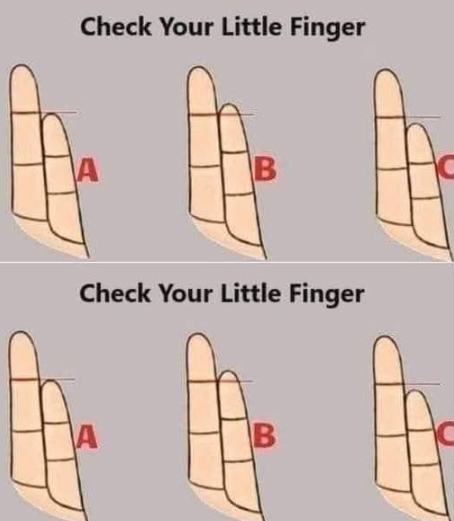
Let’s start with length. A common comparison is between the little finger and the top joint of the ring finger. If your little finger reaches above that top joint, it’s said to indicate strong communication skills. People with longer pinkies are often described as articulate, persuasive, and confident in expressing their thoughts. They may excel in storytelling, negotiation, or leadership roles where speaking clearly matters. They tend to say what they mean—and mean what they say.
On the other hand, if your little finger falls below that top joint, it’s often associated with a more reserved personality. This doesn’t mean a lack of intelligence or insight—quite the opposite. People with shorter pinkies are often deep thinkers who prefer to observe before speaking. They may be more introspective, choosing their words carefully and only sharing when they feel it truly matters. In social settings, they might come across as quiet, but those who know them understand the depth beneath the surface.
Another detail often discussed is whether the little finger stands straight or tilts outward. A straight pinky is traditionally linked to reliability and honesty. These individuals are seen as trustworthy and grounded, people who value integrity in their relationships. They’re often the ones others turn to for advice or support.
A slightly outward-tilting pinky, however, is associated with independence and a free-spirited nature. These individuals may resist conformity and prefer to carve their own path. They often have a creative streak and enjoy exploring new ideas or unconventional ways of thinking. They’re the kind of people who question norms and aren’t afraid to stand apart from the crowd.
The spacing between the little finger and the ring finger also carries meaning in palmistry. If there’s a noticeable gap when your hand is relaxed, it’s said to reflect independence in thought and action. These individuals value freedom and may be less influenced by societal expectations. They like making their own decisions and are comfortable standing alone when necessary.
If the little finger rests close to the ring finger, it may suggest a more cautious or traditional personality. These individuals often value stability, structure, and security. They may be more mindful of social norms and prefer familiar paths over risky ventures. This can make them dependable and consistent, though sometimes hesitant to step outside their comfort zone.
Even the tip shape of the little finger is said to carry meaning. A rounded tip is often linked to warmth and friendliness. These people are approachable, empathetic, and good at building connections. A more pointed tip may indicate creativity and sensitivity, often found in those drawn to artistic or imaginative pursuits. A square tip, meanwhile, is associated with practicality and logic—people who prefer clear, structured thinking over abstract ideas.
Beyond these physical traits, the little finger also symbolizes how we communicate emotionally. Do you open up easily, or do you keep your feelings guarded? Do you speak your truth, or do you hold back to avoid conflict? In this sense, the pinky becomes less about prediction and more about reflection—a small but meaningful mirror of how we interact with the world.
It’s important, however, to approach these interpretations with a balanced perspective. Unlike established fields like psychology, palmistry isn’t based on empirical evidence. It’s a cultural tradition, passed down through generations, shaped by symbolism rather than scientific validation. That doesn’t make it meaningless—but it does mean it should be taken as a tool for curiosity, not certainty.
Interestingly, part of why these interpretations feel accurate may come from something known as the Barnum effect. This is the tendency for people to find personal meaning in general statements, especially when they’re framed positively. When you read that a longer pinky means you’re a good communicator, it’s easy to see yourself in that description—even if it’s broadly applicable.
Still, there’s value in these ideas beyond literal truth. They encourage self-reflection. When you look at your little finger and consider what it might “say” about you, you’re really asking deeper questions: Am I confident in expressing myself? Do I hold back too often? How do I connect with others?
In that sense, the little finger becomes less about fate and more about awareness.
There’s also a cultural charm to these interpretations. Across different societies, hands have long been seen as symbols of identity and destiny. From ancient traditions to modern curiosity, people have always looked for meaning in the smallest details of the human body. The pinky, despite its size, carries a surprising amount of symbolic weight.
So, does your little finger truly reveal your personality? Not in a scientific sense. But it can offer a playful, thought-provoking way to explore who you are. It invites you to look closer—not just at your hand, but at your habits, your communication style, and your sense of self.
And maybe that’s the real beauty of it. Sometimes, it’s not about whether something is objectively true. It’s about the questions it inspires, the insights it sparks, and the small moments of curiosity that help us understand ourselves just a little bit better.