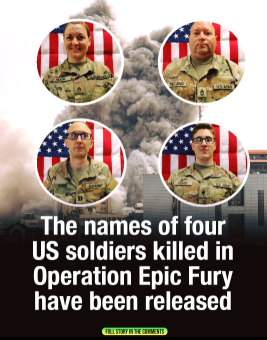
The announcement came in a quiet, solemn tone, delivered not with spectacle but with the weight of loss that words can barely carry. The Department of Defense confirmed today that four U.S. soldiers were killed during a classified mission known as Operation Epic Fury. As details of the operation remain limited, the identities of those who gave their lives have now been released, allowing a grieving nation to begin honoring not just their service, but their humanity.
The fallen soldiers have been identified as Staff Sergeant Daniel Reeves, age 34, of Fort Worth, Texas; Sergeant Alicia Moreno, age 29, of San Diego, California; Corporal Jamal Carter, age 26, of Atlanta, Georgia; and Specialist Ethan Blake, age 22, of Cedar Rapids, Iowa.
Each name carries a story far greater than rank or role. They were not only soldiers—they were sons, daughters, siblings, friends, and, in many ways, the embodiment of quiet courage that often goes unseen.
Staff Sergeant Reeves was described by his commanding officers as “a leader who never asked more of his team than he demanded of himself.” Having served multiple deployments over his twelve-year career, Reeves was known for his calm under pressure and his ability to mentor younger soldiers. At home, he was a father of two, remembered by neighbors as someone who coached youth football and never missed a chance to show up for his community.
Sergeant Alicia Moreno’s path to service was driven by purpose. A first-generation American, she often spoke about honoring her family’s sacrifices by serving her country. Fellow soldiers recall her sharp instincts and unwavering determination. She was also known for her humor—someone who could bring laughter into even the most tense environments. Her family described her as “the light of every room she entered.”
Corporal Jamal Carter had a reputation for resilience. Enlisting at 19, he quickly rose through the ranks, earning respect for his discipline and loyalty. Friends say he had plans to return home and start a nonprofit to help at-risk youth. “He always wanted to give back,” one childhood friend shared. “He never forgot where he came from.”
Specialist Ethan Blake, the youngest among them, represented the promise of a life just beginning. Known for his curiosity and enthusiasm, Blake had joined the Army straight out of high school. His fellow soldiers often joked about his endless questions, but they also admired his eagerness to learn and his bravery in the field. To his family, he was still “the kid who loved fixing things and dreaming big.”
Operation Epic Fury itself remains largely undisclosed, described only as a high-risk mission carried out under complex and dangerous conditions. Officials have stated that the soldiers were part of a specialized unit tasked with a critical objective tied to national security. While specifics are being withheld, military leadership emphasized that their actions “prevented a greater threat and upheld the safety of countless lives.”
In moments like these, the tension between secrecy and recognition becomes especially apparent. The public may never know the full details of what transpired during that operation, but what is clear is the cost. These four individuals stood at the intersection of duty and danger, making choices that ultimately led to the ultimate sacrifice.
Across the country, flags have been lowered to half-staff in their honor. Communities are beginning to organize vigils, candlelight gatherings, and moments of silence. In Fort Worth, a growing memorial of flowers and handwritten notes now surrounds the Reeves family home. In San Diego, Sergeant Moreno’s former school held an assembly to celebrate her life, sharing stories that painted a picture of determination and kindness. Atlanta and Cedar Rapids are preparing similar tributes, each community grappling with loss while striving to honor the lives lived.
Military families understand a unique kind of fear—the constant awareness that every goodbye might carry more weight than it seems. For the families of Reeves, Moreno, Carter, and Blake, that fear has now become a reality. Support services have been mobilized, and fellow service members have rallied around them, offering not just condolences but a shared understanding of sacrifice.
The broader question that often follows such loss is one of meaning. What does it mean to give one’s life in service? For some, it is about protecting freedoms; for others, it is about standing beside those who serve with you, forming bonds that transcend ordinary relationships. In many ways, it is both—and more.
Operation Epic Fury may remain partially hidden in classified reports, but the legacy of those involved will not be. Their stories, now emerging through the voices of loved ones and comrades, ensure that they are remembered not as distant figures, but as real people whose lives mattered deeply.
As the nation reflects, there is a quiet understanding that remembrance is not a single act, but an ongoing commitment. It lives in the stories we tell, the names we speak, and the moments we pause to acknowledge what was given.
Staff Sergeant Daniel Reeves. Sergeant Alicia Moreno. Corporal Jamal Carter. Specialist Ethan Blake.