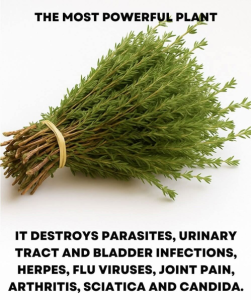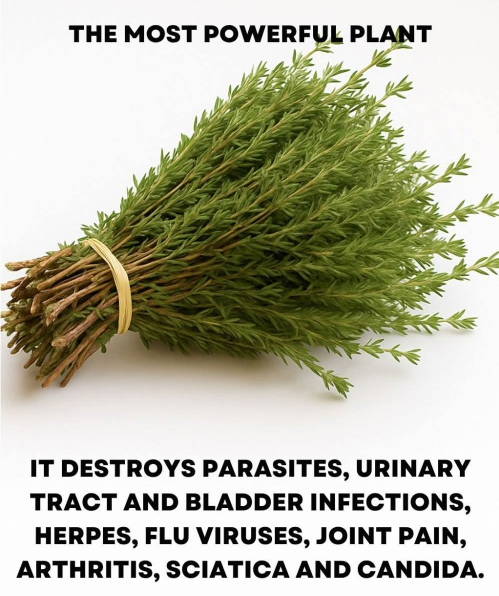
The plant in the image closely resembles thyme — a small, woody herb with thin stems and tiny, narrow leaves. Thyme is commonly used in cooking and traditional herbal remedies. While thyme does have recognized medicinal properties, the sweeping claims presented in the image deserve careful examination.
Thyme (scientifically known as Thymus vulgaris) has been used for centuries in traditional medicine. It contains compounds such as thymol and carvacrol, which have antimicrobial and antifungal properties. These compounds can help inhibit the growth of certain bacteria and fungi in laboratory settings. Because of this, thyme oil is sometimes used in natural cleaning products and diluted topical preparations.
However, saying a plant “destroys parasites, urinary tract infections, herpes, flu viruses, joint pain, arthritis, sciatica and candida” is a very broad and medically significant claim. These conditions are very different from one another. Some are caused by bacteria, others by viruses, others by fungi, and some are related to inflammation or nerve compression rather than infection at all.
For example, urinary tract infections (UTIs) are most commonly caused by bacteria such as Escherichia coli. Standard treatment typically involves antibiotics prescribed by a healthcare provider. While thyme has mild antibacterial properties, there is no strong clinical evidence proving that consuming thyme alone can cure a UTI. Delaying proper treatment for UTIs can lead to kidney infections or other serious complications.
Herpes is caused by the herpes simplex virus (HSV). There is currently no cure for herpes. Antiviral medications such as acyclovir can help manage outbreaks and reduce transmission risk. Some laboratory studies suggest that certain plant extracts, including thyme oil, may show antiviral activity in controlled environments. However, this does not mean the herb can “destroy” herpes in the human body.
Flu viruses are caused by influenza viruses, which infect the respiratory system. Prevention typically involves vaccination, and treatment may include antiviral medications. While thyme tea may help soothe cough or congestion due to its mild expectorant properties, it is not a substitute for medical treatment in severe flu cases.
Joint pain, arthritis, and sciatica are also very different conditions. Arthritis involves inflammation of the joints. Sciatica refers to pain caused by irritation or compression of the sciatic nerve. While thyme contains antioxidants that may support general health and potentially reduce inflammation slightly, it cannot reverse structural joint damage or nerve compression.
Candida refers to yeast infections caused by Candida species. Some essential oils, including thyme oil, have demonstrated antifungal activity in laboratory studies. However, internal use of essential oils can be dangerous if not done properly. Essential oils are highly concentrated and can cause irritation, toxicity, or allergic reactions.
It is important to distinguish between traditional use, laboratory research, and proven medical treatment. Many herbs, including thyme, have beneficial properties and can support overall health when used appropriately. For example:
-
Thyme tea may help relieve mild coughs.
-
Thyme has antioxidant properties.
-
It may support digestion.
-
It can have mild antimicrobial effects.
But supporting the body is different from curing serious medical conditions.
The language in the image uses absolute terms like “destroys.” In medical science, very few things “destroy” such a wide range of diseases. Each condition listed requires specific diagnosis and often specific treatment approaches. No single plant is a universal cure.
This does not mean herbs are useless. In fact, modern medicine often develops drugs from plant compounds. Many pharmaceuticals originated from plants studied carefully in laboratories and clinical trials. But those compounds are purified, dosed precisely, and tested extensively for safety and effectiveness.
Another important point is safety. Natural does not always mean safe. Consuming large amounts of herbs or using concentrated essential oils improperly can cause side effects. Thyme oil, for example, can irritate the skin and mucous membranes. Ingesting undiluted essential oil can be toxic.
When you see bold claims on images like this, it is helpful to ask:
-
Is there clinical research supporting these claims?
-
Are there peer-reviewed human studies?
-
Is dosage information provided?
-
Are risks mentioned?
Often, viral health images simplify complex medical realities.
That said, incorporating herbs like thyme into a balanced lifestyle can be beneficial. Cooking with thyme adds flavor without excess salt. Drinking mild herbal tea may be soothing. Using herbs alongside medical care — not instead of it — can be part of holistic wellness.
If someone is experiencing symptoms of a urinary tract infection, severe joint pain, persistent viral infection, or suspected parasitic infection, it is important to consult a healthcare professional. Early diagnosis and appropriate treatment prevent complications.
In summary, the plant shown — likely thyme — does have valuable natural properties. It contains antimicrobial and antioxidant compounds. It has a long history in traditional medicine. However, the claim that it single-handedly “destroys” parasites, viral infections, joint disorders, and multiple other conditions is not supported by strong clinical evidence.
Health decisions should be based on reliable medical information rather than viral graphics. Herbs can complement health, but they are not magic cures. Critical thinking, professional guidance, and evidence-based care remain the most powerful tools for protecting your well-being.