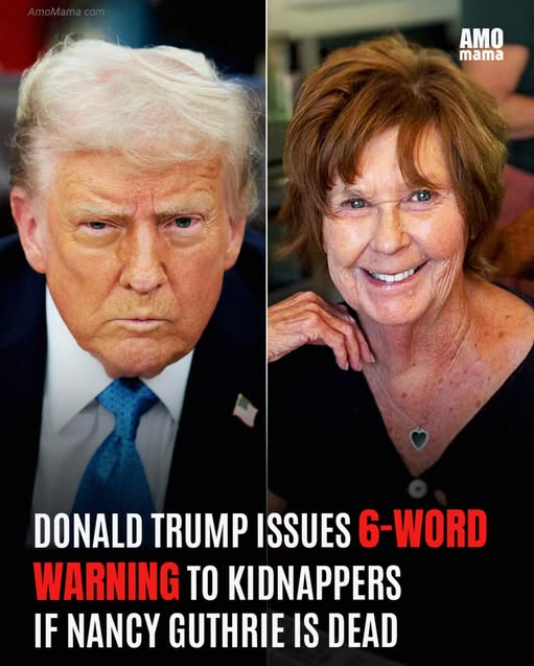

The debate over capital punishment in the United States has once again moved to the center of national conversation after former President Donald Trump publicly weighed in on the death penalty in the Nancy Guthrie case. His remarks have reignited long-standing arguments about justice, deterrence, morality, and the role of political leaders in commenting on active or high-profile criminal cases.
Although details of the Nancy Guthrie case continue to develop through the legal system, it has already drawn intense public interest. Cases involving serious violent crimes often become flashpoints for broader political debates, especially when they raise the possibility of capital punishment. In this instance, Trump’s comments have been interpreted by supporters as a firm stance in favor of law and order, while critics argue they risk influencing public perception and potentially complicating the judicial process.
Trump has long been a vocal advocate of the death penalty. During his presidency, his administration resumed federal executions after a nearly two-decade hiatus, carrying out multiple executions in 2020 and early 2021. He frequently framed capital punishment as a necessary tool to deter violent crime and deliver justice for victims and their families. In weighing in on the Nancy Guthrie case, he reportedly reiterated these views, emphasizing that particularly heinous crimes warrant the “strongest possible punishment under the law.”
Supporters of Trump’s position argue that capital punishment sends a clear message that society will not tolerate the most extreme forms of violence. They contend that, for victims’ families, the death penalty can represent a sense of closure or justice. In emotionally charged cases, calls for the harshest penalties often grow louder, especially when media coverage highlights the suffering of victims and their loved ones.
Critics, however, see the issue differently. Opponents of the death penalty point to concerns about wrongful convictions, racial and socioeconomic disparities, and the moral implications of state-sanctioned execution. They argue that no system is infallible, and that the irreversible nature of capital punishment makes it uniquely dangerous in cases where errors occur. Advocacy organizations frequently cite instances in which individuals sentenced to death were later exonerated by DNA evidence or new testimony.
The United States remains divided on the issue. While some states actively use the death penalty, others have abolished it or placed moratoriums on executions. Federal law permits capital punishment for certain crimes, but its application has varied significantly depending on the administration in power. Under Trump’s leadership, the federal government took a more assertive approach to carrying out death sentences. By contrast, subsequent leadership has paused federal executions pending policy review.
Trump’s public commentary on the Nancy Guthrie case also raises questions about the influence of high-profile political figures on ongoing legal proceedings. While former presidents are private citizens, their words still carry considerable weight. Legal experts often caution that strong public statements about specific cases could be seen as prejudicial, particularly if jury selection has not yet been finalized or if appeals are pending.
At the same time, political leaders frequently comment on crime as part of broader policy discussions. Trump has consistently positioned himself as tough on crime, advocating for strict sentencing policies and strong support for law enforcement agencies. In the context of the Nancy Guthrie case, his remarks appear consistent with that long-standing approach.
The broader public reaction has been mixed. On social media and in opinion columns, some Americans have praised Trump for “saying what others won’t,” arguing that decisive rhetoric reflects solidarity with victims. Others have criticized the comments as opportunistic or inflammatory, suggesting that complex legal matters should be resolved in courtrooms rather than debated in political arenas.
Legal scholars note that the constitutionality of the death penalty has been upheld by the U.S. Supreme Court, though the Court has imposed limitations on its use. For example, the death penalty cannot be applied to juveniles or individuals with intellectual disabilities, and certain procedural safeguards are required to ensure fairness. Even so, the ethical debate remains unresolved, with advocacy groups on both sides continuing to push for reforms or expansion.
The Nancy Guthrie case, like many high-profile criminal matters, highlights the tension between emotional response and legal principle. When crimes are particularly shocking or tragic, public sentiment can strongly favor severe punishment. However, the legal system is designed to weigh evidence carefully, ensure due process, and protect constitutional rights—even in the most disturbing cases.
Trump’s intervention underscores how crime policy remains a powerful political issue. Discussions about capital punishment often intersect with broader debates about policing, sentencing reform, prison conditions, and the rights of the accused. For some voters, a candidate’s stance on the death penalty serves as a litmus test for their broader philosophy on justice and public safety.
As the Nancy Guthrie case proceeds through the courts, it will likely continue to attract attention not only because of the alleged crime itself, but also because of the political commentary surrounding it. Regardless of individual opinions about Trump or capital punishment, the case serves as a reminder of how deeply intertwined law, politics, and public opinion can become.
In the end, decisions about sentencing will rest with prosecutors, defense attorneys, judges, and potentially jurors—not politicians. Yet when prominent figures like Donald Trump speak out, their words shape national conversation. Whether his comments ultimately influence public perception or remain one voice among many in a complex debate, they have undeniably added another layer to an already emotionally charged case.
The ongoing dialogue about the death penalty reflects broader questions about justice in America: How should society respond to its most serious crimes? What balance should be struck between punishment and the possibility of rehabilitation? And how can the legal system ensure fairness while addressing the demands of victims and communities for accountability?