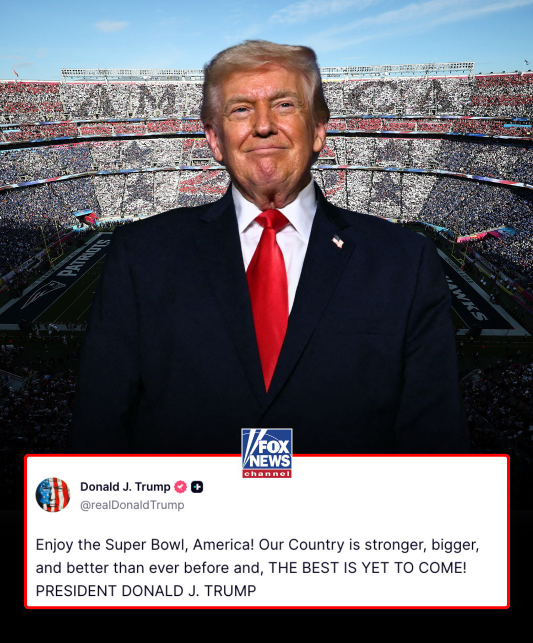
On Super Bowl Sunday, February 8, 2026, President Donald Trump issued a public message to the American people that was deeply patriotic and upbeat — capturing his long-standing rhetorical emphasis on national strength and optimism. In a post on social media, Trump encouraged Americans to enjoy the big game and spoke about the country itself, saying that the United States is “stronger, bigger, and better than ever before” and adding that “the best is yet to come.”
This kind of message fits a familiar pattern. Throughout his political career, Trump has frequently used language emphasizing American greatness and an optimistic future, using phrases like “best is yet to come” and “keep winning,” which are staples of his speeches and campaign rhetoric.
What Trump Said and Where It Happened
Trump’s Super Bowl message wasn’t delivered in a formal speech at the White House or in Congress. Instead, he posted it online — likely on his preferred platform, Truth Social — while millions of Americans were tuning in to watch Super Bowl LX. This method of communication reflects how modern presidents increasingly use social media to speak directly to the public without going through traditional press channels.
His message had two key components:
-
Good wishes for Americans enjoying the game — urging them to enjoy the Super Bowl as a uniquely American tradition.
-
A broader patriotic statement — asserting that the nation is thriving and that the future holds even more promise: “Our country is stronger, bigger, and better than ever before and the best is yet to come!”
This phrasing taps into a core theme of Trump’s political identity: portraying the United States as powerful and elevated, with an even brighter future ahead. That message tries to blend universal optimism with distinct political messaging about national success.
What It Means in Trump’s Broader Narrative
Trump’s words during the Super Bowl fit into a longer pattern of rhetoric that has been central to his political brand for many years:
1. Repeated Optimistic Slogans
Trump often uses a mix of celebratory and forward-looking phrases in public appearances. For example:
-
During campaign rallies, he has repeatedly said phrases like “the best is yet to come” as a way to energize supporters about future achievements.
-
Earlier in his career, during speeches to political groups, he spoke about making America stronger, safer, bigger, and better than ever.
These recurrent rhetorical themes are meant to reinforce the idea that America, under his leadership, is on a positive trajectory — and that this progress will continue.
2. Patriotism as a Strategic Message
Trump’s Super Bowl statement wasn’t just about football; it was about connecting a major American cultural tradition with national identity. The Super Bowl is not merely a sporting event — it is a cultural spectacle with enormous viewership and a place in the national imagination. By tying his message to that event, Trump used the moment to speak to a broad audience about national pride.
This approach leans into patriotism as a unifying theme. Presidents often do this — appealing to shared national values during major holidays or cultural events — but Trump’s style tends to be more direct and assertive in its framing.
Why It Matters Politically
Trump’s message on Super Bowl Sunday came at a time of intense political and cultural polarization. Football — and especially the Super Bowl — remains one of the most widely viewed entertainment spectacles in America, attracting people across political lines. But even around that cultural moment, political controversy was swirling.
In the same timeframe, Trump publicly criticized this year’s official Super Bowl halftime show — headlined by globally popular artist Bad Bunny — calling it “absolutely terrible” and “an affront to the greatness of America.” That criticism underscored a broader cultural clash that has emerged between Trump’s base and segments of mainstream entertainment culture.
By contrast, his Super Bowl message about American strength and optimism was intended to sound uplifting, even if it was intermixed with other, more sharply critical commentary later. This contrast — positive language about the country versus harsh critique of specific cultural moments — is typical of his communication style.
Reception and Reaction
Reactions to Trump’s message were mixed and often split along partisan lines:
Supporters
For many of his supporters, the Super Bowl message reinforced familiar themes they appreciate about his leadership: strong national identity, economic growth, and assertive optimism about America’s future. This demographic might see his reference to the country being “stronger, bigger, and better than ever before” as an affirmation of their view that the U.S. is thriving. They also tend to interpret “the best is yet to come” as a call to continued progress. This kind of messaging resonates with people who view America’s current condition through a lens of competitive national confidence.
Critics
Critics, meanwhile, were quick to challenge both the sentiment and the timing of the message. Some commentators noted that while he spoke about national strength, he was physically absent from the game, having chosen not to attend and citing travel distance as a factor. Others seized on his criticisms of the halftime show and argued those comments detracted from the unifying nature of the event.
Polls following the game indicated that a notable segment of Americans — including some who watched the halftime show — felt that the featured artist, Bad Bunny, represented a broader, more modern sense of American culture than Trump’s messaging. One survey found that some viewers believed Bad Bunny better represented America than the president did.
Media Coverage
Media outlets covering the Super Bowl and Trump’s comments framed the situation as juxtaposing two narratives: one celebrating traditional patriotism and another highlighting cultural evolution and inclusivity. The mix of enthusiastic supporters and vocal detractors reflects how the Super Bowl moment became another platform for broader political and cultural debates.
Cultural and Political Context
When political leaders speak during major cultural moments like the Super Bowl, they’re trying to do more than simply wish people well. They are attempting to shape how the public interprets the event and, in turn, how the nation thinks about itself.
In Trump’s case, the Super Bowl message was an attempt to tie his view of American greatness to one of the country’s most iconic sporting events, using language that reinforces his long-standing themes of optimism and national pride. His choice of words — especially “the best is yet to come” — is consistent with how he frames progress and achievement in both political speeches and campaign rhetoric.
At the same time, the reaction to his message shows that cultural moments like the Super Bowl continue to be battlegrounds for larger debates about identity, belonging, and national values.
Bottom Line
President Trump’s Super Bowl message — declaring that the United States is “stronger, bigger, and better than ever before” and expressing that “the best is yet to come” — was both a celebration of a beloved American tradition and a strategic piece of political communication. It leaned into familiar themes of patriotism, optimism, and forward momentum that have defined much of his public rhetoric.
Whether one agrees or disagrees with the assertion, the message reflects a broader attempt to connect American cultural milestones with national identity and political narrative — a common practice among leaders in a highly polarized political climate.