1. What Was the “All-American Halftime Show”?
In early February 2026, Turning Point USA (a conservative nonprofit organization) produced an online concert called the “All-American Halftime Show.” It was positioned as an alternative to the official Apple Music Super Bowl LX halftime show, which was headlined by global superstar Bad Bunny.
-
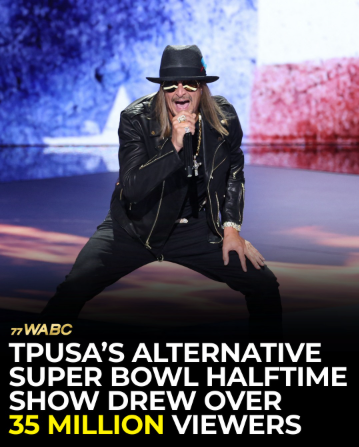
The show featured performances by country and rock artists such as Kid Rock, Brantley Gilbert, Lee Brice, and Gabby Barrett — and was threaded with patriotic themes.
-
It was broadcast primarily on YouTube (as well as other online platforms like Rumble) at the same time as the NFL’s official halftime show on February 8, 2026.
-
Organizers framed it as a cultural rejoinder to what they perceived as the supposed liberal or “anti-American” messaging in Bad Bunny’s performance.
Turner Point’s spokesperson Andrew Kolvet spoke to media outlets touting the event as a success, painting it as a meaningful cultural moment for the organization.
2. What Viewership Numbers Are Reported?
There are different figures circulating — and it’s important to untangle them:
Live Concurrent Viewership
-
According to The New York Times and monitoring outlets cited on the event’s Wikipedia page, the YouTube livestream peaked at roughly 5.7 million to 6.1 million concurrent viewers* — meaning that at peak, that many people were watching simultaneously.
-
Similar figures appear in news reports: one notes the live stream peaked at more than 6 million concurrent viewers.
This is the figure Andrew Kolvet and TPUSA spokespeople referenced when promoting the show’s reach.
Total Views After the Event
-
In the days following, the performance video amassed millions more views overall. Billboard and other outlets reported around ~19 million views on YouTube alone.
-
Some news summaries and conservative commentary amplified the figure further, claiming over 25 million views across platforms by some counts.
Important distinction: Live concurrent views (people watching at the same moment during the broadcast) and total views accumulated later (from replays, clips, highlights, and repeat watches) are very different metrics — and mixing them can make the livestream seem far bigger than it was in real time.
3. How Does That Compare to the Official Super Bowl Halftime Show?
This contrast is widely cited in coverage because it frames the cultural impact:
Bad Bunny’s Official Show
-
The NFL’s official halftime performance by Bad Bunny reportedly drew well over 100 million live viewers on traditional broadcast platforms, making it one of the most-watched halftime shows ever.
-
YouTube and social media views for Bad Bunny’s performance added tens of millions more in the days after.
Turning Point USA Alternative
-
In contrast, TPUSA’s show — even using the largest honest estimates — peaked around ~6 million concurrent viewers online and later hit ~20 million total views.
-
That is less than 5 % of the audience of the official halftime show and far below typical Super Bowl viewership figures.
So while TPUSA’s online numbers may seem large in isolation, they are far below mainstream broadcast benchmarks for halftime programming.
4. What Andrew Kolvet Said (and How It’s Been Covered)
Andrew Kolvet, a spokesperson for Turning Point USA, called the show a success, noting the millions of viewers — a point conservative media and TPUSA allies happily amplified.
Kolvet and other TPUSA supporters have described the event as culturally significant, positioning it as a “shot across the bow” in broader debates over American culture, media, and entertainment.
The messaging from TPUSA and some Republican commentators leaned into the idea that this viewership demonstrated widespread dissatisfaction with the NFL’s decision to feature Bad Bunny — portraying their alternative as resonating with conservative audiences.
5. Criticism, Skepticism, and Controversy
Despite the claims of success, the event has been criticized — sometimes sharply — from multiple angles:
Skepticism About Metrics
-
Analysts and journalists have highlighted how livestream numbers on platforms like YouTube aren’t directly comparable to Nielsen broadcast ratings, and they can be easily misinterpreted or inflated by replay traffic.
-
Debate emerged over whether the touted viewership was actually bots or brief clicks rather than sustained engagement.
Performance Reception
-
Many commentators mocked the performances, with particular attention to accusations that Kid Rock appeared to lip-sync portions of his set, undermining claims of a polished entertainment event.
Political and Cultural Commentary
-
Media critics argued that the event was less a musical moment and more of a political statement — one that ultimately did not break into broader cultural consciousness the way the official halftime show did.
-
Opinion pieces and social media reactions labeled it everything from a “culture war stunt” to a genuine expression of conservative identity politics around mainstream entertainment.
6. What It All Means
What TPUSA’s halftime show highlights isn’t just numbers on a screen — it underscores broader trends in American culture:
Cultural Polarization
-
The competing halftime shows show how divisions in the U.S. have moved beyond politics and into pop culture itself. Conservative groups saw the NFL’s choice of a Puerto Rican artist celebrating Latin culture as symbolic; their response was to create an alternative that they said represented “faith, family, and freedom.”
Media Fragmentation
-
The contrast between traditional mainstream broadcast ratings and online livestream viewership illustrates the fragmentation of audiences. People now access content in many places, which means counterprogramming can exist even if it doesn’t approach mainstream audience sizes.
Communication Ecosystem
-
For TPUSA itself, the event may have succeeded as a rallying point and media moment for its supporters — whoever tuned in — even if it made a relatively small dent in the broader cultural landscape.
7. Bottom Line
Here’s the essential breakdown:
-
Live concurrent peak: roughly 5.7–6.1 million viewers on YouTube — the figure referenced by Andrew Kolvet and TPUSA spokespeople.
-
Total views after: approximately ~19–25 million views across platforms over time.
-
In contrast, Bad Bunny’s official Super Bowl halftime show reached well over 100 million viewers during the broadcast, making it dramatically larger by any conventional measure.
-
Analysts and critics have raised questions about the meaning of the numbers TPUSA cites, especially when compared to traditional TV ratings or to the official halftime show’s massive reach.
While TPUSA supporters heralded the event as a cultural moment, most media coverage has treated it as a notable but relatively niche counterprogramming experiment — one that sparked debate but did not close the gap with mainstream entertainment consumption