What Happened: The Video Post and Immediate Response
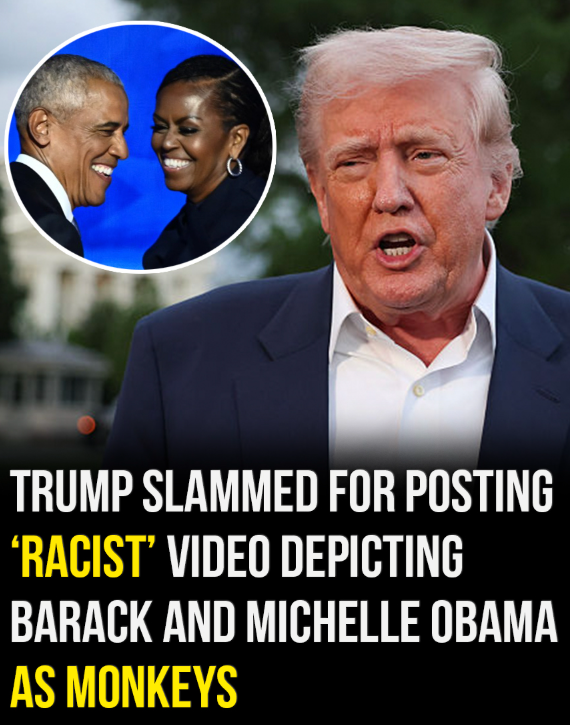
In early February 2026, President Donald Trump shared a video on his social platform Truth Social that sparked a firestorm of controversy. The clip was part of a roughly one-minute video that promoted false conspiracy claims about alleged election fraud in the 2020 U.S. presidential election. Toward the end of that video — lasting only a second or two — the faces of former President Barack Obama and former First Lady Michelle Obama were superimposed onto the bodies of primates, set against imagery resembling a jungle and accompanied by the song “The Lion Sleeps Tonight.”
Shortly after it appeared — approximately 12 hours later — the video was deleted from Trump’s account, but not before it had been widely circulated and heavily criticized.
The timing of the post — early in Black History Month — added to the sensitivity and criticism, as many observers noted that the imagery hearkened back to historically racist tropes of Black people being compared to animals.
Why It Was Viewed as Racist
The depiction of Black people as monkeys or apes is a deeply offensive and historically racist trope. For centuries, racist imagery and caricatures have used comparisons between people of African descent and animals to demean and dehumanize them — a tactic that has been widely condemned by civil rights groups, historians, and cultural commentators.
Even though the segment was brief and embedded in a broader clip with political messaging, many civil rights advocates said it wasn’t just political commentary but a harmful echo of racist imagery that resonated deeply with America’s history of racism.
Civil rights organizations, including the NAACP, described the post as disgusting and deeply offensive, noting that such imagery perpetuates harmful stereotypes and dehumanizes Black Americans.
Official Responses and Reactions
Trump and the White House
President Trump and his spokespeople reacted to the backlash with a mix of defense and deflection:
-
Trump said he hadn’t seen the entire video before it was posted, claiming he only watched the beginning and did not notice the offensive ending. He told reporters he didn’t believe it was a mistake yet said he would not apologize.
-
The White House initially defended the post, with press secretary Karoline Leavitt dismissing the outrage as “fake outrage” and framing the clip as part of an “internet meme video” meant to depict Trump as “King of the Jungle.”
-
After the criticism intensified, the White House shifted its story, blaming an unnamed staffer for the posting and saying it was posted inadvertently.
Despite intense pressure, Trump repeatedly said he would not apologize, saying, “No, I didn’t make a mistake,” and defending the decision to share the broader video content.
Political and Public Outrage (Bipartisan)
What made this controversy notable was its bipartisan backlash — with critics coming from both sides of the political aisle:
-
Republican Senator Tim Scott, the only Black GOP senator, said the video was “the most racist thing I’ve seen out of this White House” and urged Trump to remove it.
-
Other Republicans, like Rep. Mike Lawler and Sen. Pete Ricketts, also called the post offensive and said the White House should apologize.
-
Prominent Democrats, including House Minority Leader Hakeem Jeffries and Senator Raphael Warnock, strongly condemned the post as racist and egregious.
-
California Gov. Gavin Newsom called the depiction “disgusting behavior by the President.”
Across social media and public forums, many commentators, activists, and ordinary citizens also expressed shock and disappointment at the post, describing it as an example of dehumanizing rhetoric that has no place in public discourse.
Cultural and Celebrity Condemnation
The reaction wasn’t limited to politicians:
-
Whoopi Goldberg, actress and voice talent from The Lion King franchise, publicly slammed the racist content and criticized Trump’s team for misusing imagery and failing to ‘check facts’ before posting, highlighting that the original Lion King film does not even feature apes.
-
Other cultural figures and critics similarly condemned the use of racist stereotypes, pointing out the broader implications of such imagery when shared by a sitting president.
Broader Context and Implications
The controversy has raised questions beyond a single offensive post:
1. Racism in Political Messaging
Many critics saw this episode not as an isolated mistake but as part of a pattern where racially insensitive or inflammatory content is used in political communication. Commentators on both ends of the political spectrum warned that even brief racist imagery can deepen divisions and legitimize harmful stereotypes.
2. Social Media Oversight and Vetting
The episode exposed apparent weaknesses in how the Trump administration (or associated accounts) vets content before posting to official or semi-official channels. White House defenders claimed the post was accidental or a staff error, but the swift and broad distribution before deletion suggests gaps in content control.
3. Black History Month and Symbolism
Because the incident occurred during Black History Month — a period dedicated to recognizing African American history and achievement — critics argued it was especially tone-deaf and offensive to share content that evokes racist caricatures.
Conclusion
The episode of Donald Trump posting a video that depicted Barack and Michelle Obama as monkeys remains a flashpoint in U.S. political discourse. It prompted:
-
Bipartisan condemnation for its racist imagery.
-
Defensive responses from Trump and his press team.
-
Public and cultural criticism, including from figures like Whoopi Goldberg.
-
Questions about social media oversight and the normalization of racially offensive content in politics.
Whether viewed as a deliberate provocation or a careless misstep, the incident has highlighted how the use of racist imagery — especially by powerful political figures — continues to inflame public debate, shape perceptions of racial attitudes in politics, and influence conversations about leadership, responsibility, and respect in public discourse.