1. The Moment That Triggered the Debate
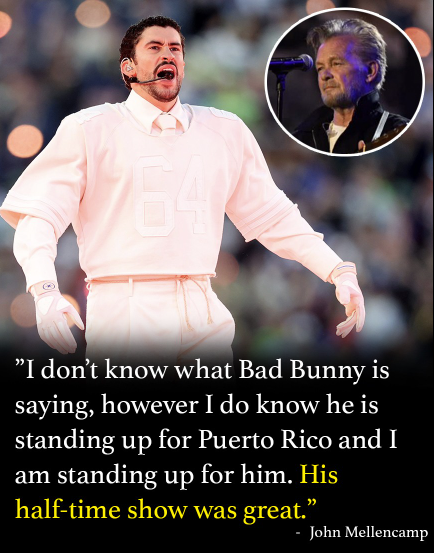
On February 8, 2026, Latin music superstar Bad Bunny (Benito Antonio Martínez Ocasio) headlined the Apple Music Super Bowl LX Halftime Show at Levi’s Stadium in Santa Clara, California. His ~14-minute set was both a celebration of Latin culture and a subtle political statement — complete with vibrant genre fusion (from reggaeton and salsa to bomba and plena), surprise guest collaborators like Lady Gaga and Ricky Martin, and a closing message emphasizing unity.
As he exited the stage, Bad Bunny held up a football with the words “Together we are America” and left a lasting impression of inclusivity and celebration.
But while many hailed it as a groundbreaking and emotional performance, the show quickly became a cultural flashpoint — igniting debates over identity, patriotism, and what “America” means in 2026.
2. The Rock Legend’s Defense: John Mellencamp Steps In
Among the many voices reacting, **rock veteran John Mellencamp emerged as one of the most prominent defenders of Bad Bunny’s show and message.
Posting on X (formerly Twitter) after the performance, Mellencamp wrote:
“I don’t know what Bad Bunny is saying, however I do know he is standing up for Puerto Rico and I am standing up for him. His halftime show was great.”
This simple but unmistakable endorsement is powerful for several reasons:
a) From Rock to Cultural Commentary
Mellencamp, 74, is a figure deeply associated with the heartland and Americana rock. His music — especially classics like “Jack & Diane” and “Small Town” — is built on themes of working-class life and small-town America. His support thus carries cultural weight beyond a typical celebrity tweet.
b) Acknowledging Cultural Expression
Mellencamp explicitly acknowledges that while he may not understand the Spanish lyrics — a nod to the linguistic and cultural barriers that often fuel criticism — he sees the show’s cultural and emotional resonance. His argument isn’t merely about liking the song or the performance: it’s about recognizing what Bad Bunny represents — pride in heritage, visibility for a historically under-represented community at one of the world’s largest entertainment moments, and a message of unity.
c) Standing for Artistic Expression
Beyond simple praise, Mellencamp’s statement functions as a broader stance for artistic freedom and diversity. His message is not simply “I liked it” — it’s “I support someone standing for his identity and culture.” In doing so, he implicitly rejects the notion that Halftime Show entertainment should conform narrowly to tradition or to a single cultural definition of “American.”
3. A Polarized Reaction Landscape
While Mellencamp and many others praised the performance, Bad Bunny’s Halftime Show also drew intense backlash — especially from certain conservative figures and commentators.
a) Donald Trump’s Criticism
Former President Donald Trump described the performance negatively, calling it an “affront to the greatness of America” and ridiculing it as lacking inspiration.
Trump’s critique fits a broader narrative used by some: that the NFL and entertainment industries are prioritizing diversity and identity politics over traditional cultural values. That framing has animated much of the criticism.
b) Celebrity Pushback Against the Critics
In contrast, multiple stars reacted positively:
-
Adam Sandler called the performance “unbelievable” and “loose, happy, made everybody ecstatic.”
-
Kacey Musgraves claimed that Bad Bunny’s show made her feel “more proudly American than anything Kid Rock has ever done.”
-
Gavin Newsom and other public figures celebrated the performance’s inclusive message.
c) Controversial Voices
Some criticism veered into cultural and even personal attacks:
-
Influencer Jake Paul called Bad Bunny a “fake American citizen” and encouraged audiences to turn off the halftime show, although his comments drew their own backlash.
-
Chris Brown posted that “the Super Bowl needs me” instead — a more ego-driven jab than a substantive critique.
These polarized responses reflect broader cultural tensions in the U.S. around immigration, identity, language, and national identity — not just music.
4. Why This Matters: Cultural Identity and America in 2026
Bad Bunny’s Halftime Show became more than a musical event — it became a symbolic battleground for defining what America is and who gets to shape its cultural narrative.
a) Puerto Rican Representation on the Biggest Stage
Bad Bunny is Puerto Rican, and as such a U.S. citizen. His performance — delivered in Spanish, steeped in Latino rhythms — put Latin culture front and center on an unparalleled platform.
For many, this was a powerful affirmation of a community that has historically fought for visibility in mainstream U.S. media. For others, it triggered discomfort or hostility — an expression of anxieties about national identity and cultural change.
Mellencamp’s support stands out because he didn’t dismiss the performance for its language or cultural origin. Instead, he honored what the performance represented — a pride in heritage, and a stance against marginalization.
b) Art vs. Politics — Or Both?
Though the Halftime Show is entertainment, its themes — unity, diversity, love overcoming hate — naturally resonate with real political and social issues. Whether intentionally or not, Bad Bunny’s show spoke to broader debates about immigration, multiculturalism, and what unity in America looks like.
Mellencamp’s endorsement is an acknowledgment of that deeper context, suggesting that art can’t be divorced from the lived experiences and identities of performers.
c) A Cultural Watershed Moment
When a rock legend supports a Latin trap artist’s message of cultural pride on America’s biggest stage, it signals more than cross-genre appreciation — it signals a shift in cultural power. It represents a movement toward a broader, more inclusive interpretation of American identity.
5. Conclusion: A Moment Bigger Than Music
The ripple effects from Bad Bunny’s Super Bowl Halftime Show extend beyond pop music — they reverberate through culture, politics, and identity in the U.S.
John Mellencamp’s support is notable not just because he liked the show, but because his words convey recognition of cultural struggle, pride, and humanity. By saying “I stand with him” regardless of language or genre differences, he encapsulates how art can bridge divides.
Whether you agree with him, disagree, or fall somewhere in between, this moment represents a broader conversation about who gets to define American culture and values in 2026 — and how music can be both a reflection and a catalyst for that conversation.