What Happened: The Viral Video Post
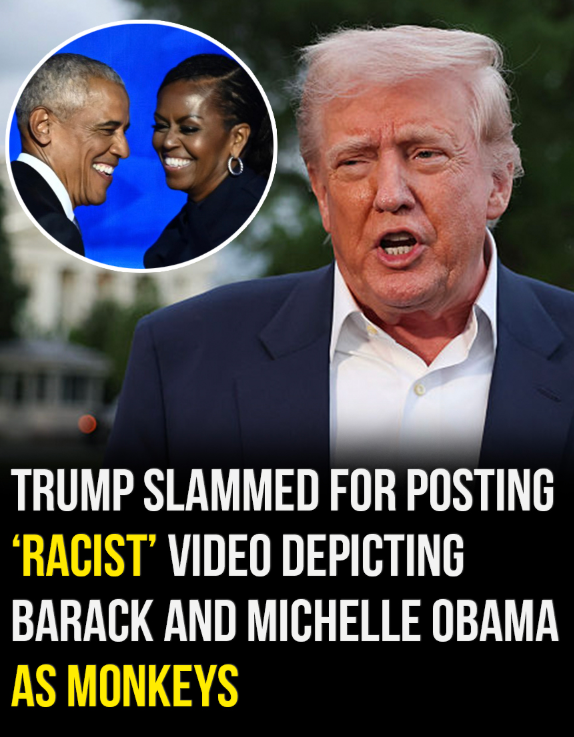
President Donald Trump posted a controversial video on his social media platform Truth Social late one night in early February 2026 that included an offensive and racist depiction of former President Barack Obama and former First Lady Michelle Obama. In a brief moment at the end of the clip, the Obamas’ faces were superimposed on the bodies of apes or monkeys — a dehumanizing racial trope with a deeply offensive historical context.
The video itself was about false claims regarding the 2020 U.S. presidential election, but the offensive imagery of the Obamas overshadowed the rest of the content. After widespread criticism, the video was deleted from Trump’s account — a rare acknowledgment of backlash from his social media team or the White House.
Immediate Reaction and Bipartisan Backlash
Reaction to the post was swift and strong from across the political spectrum — something uncommon even in deeply divided U.S. politics. Many lawmakers, commentators, civil rights leaders, and public figures condemned the shared content as racist, offensive, and unacceptable.
Republican Response
Even some Republicans publicly denounced the post:
-
Senator Tim Scott (R-SC), the only Black Republican in the Senate, described the video as “the most racist thing I’ve seen out of this White House” and urged its removal.
-
Representative Mike Lawler (R-NY) called the content “wrong and incredibly offensive.”
-
Several other GOP members, including Senators Roger Wicker, Susan Collins, and John Curtis, said the imagery was unacceptable and urged that it be taken down and addressed properly.
Democratic Response
Democratic leaders were even more forceful in their criticism:
-
House Democratic Leader Hakeem Jeffries labeled the imagery racist and bigoted, and defended the Obamas as “brilliant, compassionate, and patriotic Americans.”
-
Senate Minority Leader Chuck Schumer called the depiction “racist, vile, and abhorrent,” warning that it degraded national discourse.
-
Civil rights groups, including the NAACP, condemned the post for drawing on harmful racial stereotypes historically used to dehumanize Black people.
The bipartisan nature of the backlash — with criticism from both parties — underscored how profoundly offensive many found the post, even among some conservative leaders.
Trump’s Defense and White House Response
Trump’s Public Comments
When asked about the controversy by reporters, Trump claimed he had not seen the offensive portion of the video before it was posted, saying he “only watched the beginning.” He insisted he would not apologize for the post, stating, “I didn’t make a mistake.”
Trump also said he did condemn the imagery itself, but repeatedly refused to take personal responsibility, and instead attributed the problematic post to a staffer’s error.
White House’s Shifting Defense
The White House initially tried to downplay the controversy:
-
Press Secretary Karoline Leavitt described the clip as part of an internet meme depicting Trump as the “King of the Jungle” with Democrats shown as characters from “The Lion King.” The remark drew further criticism for minimizing the obvious racial implications.
-
As outrage grew, the White House later claimed the post was shared erroneously by a staffer, not by Trump personally, and emphasized that the video had been removed.
Despite the deletion, Trump’s refusal to apologize became a central focus of the controversy, with critics saying the response was inadequate.
Historical Context: Why It Matters
The depiction of Black people as apes or monkeys has a long and deeply harmful history in the United States and beyond. This trope was widely used in racist propaganda during the 19th and early 20th centuries to justify inequality, segregation, and violence. Depictions like those in the video are not neutral humor; they tap into decades of dehumanizing imagery.
The fact that the offensive segment appeared during Black History Month — a time when the nation recognizes the contributions and struggles of Black Americans — added to the sensitivity and outrage.
Critics also linked the incident to Trump’s past controversies involving race, such as his promotion of the “birther” conspiracy questioning Barack Obama’s birthplace. They argued the video was part of a broader pattern of racially insensitive rhetoric.
Public Reaction and Media Commentary
Outside of political leaders, media commentators and cultural figures weighed in:
-
Comedian and commentator Bill Maher criticized the White House defense as “lame,” likening the incident to prior instances in which public figures defended racist conduct.
-
Public discourse on social media reflected both condemnation and debate about intent, media focus, and political ramifications. Some users suggested the post was an attempt to distract from other issues, while others called for accountability.
The controversy quickly became one of the most talked-about political stories of the week, drawing attention from major news outlets worldwide.
Impact on Trump’s Presidency and Political Climate
While Trump has weathered many controversies, this incident represents a unique moment in his second term — because it triggered criticism from within his own party and highlighted ongoing tensions about race and political discourse in America.
Many observers see the episode as illustrating deeper issues:
-
Social media and political communication: How world leaders use platforms like Truth Social, and the risks of sharing content without vetting.
-
Racial sensitivity in public office: The expectations placed on presidents and prominent figures to avoid imagery that reinforces historic bigotry.
-
Political polarization: How offensive content can deepen divides while prompting rare bipartisan condemnation.
Even among some Trump supporters who rejected criticism of the post as overblown, the incident sparked conversations about taste, responsibility, and the line between satire and bigotry.
Where Things Stand Now
As of today’s reporting:
-
The racist video has been removed from Trump’s Truth Social account.
-
Trump has refused to apologize and claims he did not see the offensive end of the video before it was posted.
-
Members of both political parties demand accountability and called for clearer condemnation and lessons learned.
-
The debate continues about how leaders should handle racially sensitive content and the impact of digital media on political discourse.