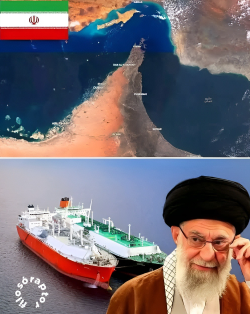
BREAKING: Iranian Parliament Approves the Closure of the Strait of Hormuz — What It Means for the World
In a dramatic escalation of regional tensions, Iran’s parliament has reportedly approved a measure calling for the closure of the Strait of Hormuz, one of the most strategically vital waterways on the planet. Although such a move would still require approval from Iran’s top leadership and security bodies to be implemented, the signal alone has sent shockwaves through global markets and diplomatic circles. The narrow passageway, just about 21 miles wide at its narrowest point, carries roughly one-fifth of the world’s traded oil and a significant share of liquefied natural gas. Any disruption there would have consequences far beyond the Middle East.
The Strait of Hormuz lies between Iran to the north and Oman and the United Arab Emirates to the south. It connects the Persian Gulf with the Arabian Sea and the broader Indian Ocean. Every day, dozens of supertankers laden with crude oil and gas pass through its shipping lanes, supplying energy to Asia, Europe, and North America. Countries such as Saudi Arabia, Iraq, Kuwait, the UAE, and Qatar rely heavily on this corridor to get their exports to market. Because of this, the strait has long been described as the “chokepoint” of global energy.
Iran has, for decades, used the threat of closing the Strait of Hormuz as a strategic lever whenever it feels cornered by sanctions, military pressure, or diplomatic isolation. However, actually attempting to block or seriously disrupt traffic would mark a major turning point. It would almost certainly draw in the United States and its allies, who maintain a strong naval presence in the region specifically to ensure freedom of navigation. The Fifth Fleet, based in Bahrain, has the stated mission of protecting commercial shipping in these waters.
The parliamentary approval, as reported, reflects rising internal pressure within Iran to respond forcefully to what it sees as external aggression. From Tehran’s perspective, economic sanctions have strangled its economy, limiting oil exports, weakening its currency, and fueling domestic discontent. Hardline factions argue that if Iran cannot freely sell its own oil, then no one else in the region should be able to do so either. Closing the strait is viewed by these voices as a way to impose costs on the global system and force negotiations on Iran’s terms.
Still, it is important to understand Iran’s political structure. The parliament can pass resolutions and bills, but ultimate authority over military and national security matters rests with the Supreme Leader and institutions like the Supreme National Security Council and the Islamic Revolutionary Guard Corps. In past crises, similar parliamentary moves have been more symbolic than operational. They send a message of defiance without immediately triggering military action. Whether this time is different depends on how far Iran’s leadership is willing to go in confronting the United States and its partners.
If Iran were to attempt a closure, it would likely not mean a neat, formal declaration followed by a simple blockade. Instead, disruption could take many forms: naval exercises that intimidate shipping, the deployment of mines, harassment of tankers by fast attack boats, cyber operations against port infrastructure, or even the seizure of individual vessels. Iran has invested heavily in asymmetric warfare capabilities designed precisely for this kind of scenario. Small, fast craft, coastal missile batteries, and drones can make the narrow waters of the strait extremely dangerous for commercial traffic.
The global economic impact of even a short-lived disruption would be severe. Oil prices would almost certainly spike within hours of credible reports that shipping was under threat. Energy-importing countries in Asia, especially China, Japan, South Korea, and India, would feel immediate pressure, as much of their crude comes from the Gulf. Europe, already sensitive to energy supply issues after recent geopolitical crises, would also be affected. Higher oil and gas prices feed into inflation, increasing costs for transportation, manufacturing, and basic goods. For consumers, this could mean more expensive fuel, higher food prices, and overall economic uncertainty.
Financial markets tend to react quickly to geopolitical risk. Stock indices often drop on news of potential conflict in the Middle East, while investors rush into so-called safe havens like gold and government bonds. Insurance premiums for ships transiting the region would rise sharply, and some shipping companies might temporarily halt operations, further tightening supply. The ripple effects would not stay confined to energy markets; they would touch virtually every sector of the global economy.
Diplomatically, a move toward closing the Strait of Hormuz would put many countries in a difficult position. The United States would likely push for a united international response to keep the waterway open, possibly through naval escorts or multinational task forces. European allies, while eager to avoid war, would be under pressure to support freedom of navigation. At the same time, countries like China and Russia, which have complex relationships with Iran, would have to balance their strategic interests with the need for stable energy flows.
For Iran itself, the risks are enormous. While threatening the strait is a powerful bargaining chip, actually acting on it could invite overwhelming military retaliation. The U.S. and its allies have the capacity to clear mines, protect shipping, and strike Iranian military assets if necessary. A direct confrontation could damage Iran’s infrastructure, further isolate its economy, and potentially destabilize the region in ways that Tehran cannot fully control. It could also backfire diplomatically, turning even sympathetic countries against Iran if they see global commerce being deliberately endangered.
There is also the regional dimension. Gulf Arab states, many of which already view Iran with deep suspicion, would see a closure as an existential threat to their economic lifelines. This could accelerate arms buildups, deepen security partnerships with Western powers, and harden political attitudes for years to come. The chances of miscalculation would rise, with more ships, drones, and weapons systems operating in close proximity in tense conditions.
For ordinary people, both inside and outside the Middle East, the implications are sobering. In Iran, citizens already struggling with inflation and limited opportunities could face even harsher conditions if the crisis leads to new sanctions or military clashes. In energy-importing countries, households would feel the squeeze from higher prices. Global uncertainty tends to hit the most vulnerable populations hardest, as governments divert resources to security and defense rather than social and economic development.
At this stage, the key word is still “approval” by parliament, not “implementation.” History suggests that Iran often uses such announcements as part of a broader strategy of signaling and negotiation rather than as a prelude to immediate action. The message is clear: Iran wants the world to understand that it has leverage, and that ignoring its grievances carries costs. Whether this will lead to renewed diplomacy or a dangerous escalation depends on how all sides respond in the coming days and weeks.
In the end, the Strait of Hormuz is more than just a strip of water on the map. It is a symbol of how interconnected the modern world has become. A decision taken in Tehran can affect gas prices in Tokyo, inflation in Berlin, and stock markets in New York. That interdependence makes the situation both more fragile and more important to handle with care. The coming period will test the ability of global leaders to manage crisis without tipping into conflict