🔥 What Happened: A Dangerous Naval Confrontation
⚓ Near-Collision at Sea
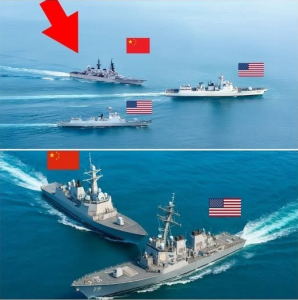
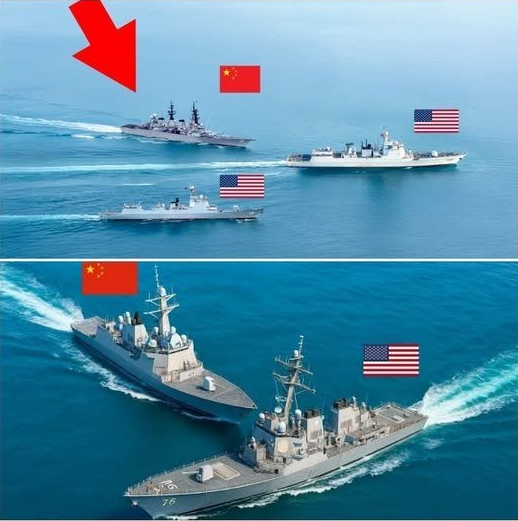
In a high-stakes maritime standoff, a U.S. Navy destroyer conducting a “freedom of navigation” operation passed within 12 nautical miles of disputed reefs in the South China Sea — a region China claims almost entirely. According to U.S. officials, a Chinese warship maneuvered aggressively, approaching the U.S. destroyer within just yards, forcing the American ship to take evasive action to avoid a collision at sea.
From Washington’s perspective, these patrols are routine exercises to assert navigational rights recognized under international law. Beijing, however, views them as provocations and infringements on its declared sovereignty.
This particular encounter didn’t escalate into open warfare, but it highlighted how easily a miscalculation could turn into something far more serious.
📍 The Strategic Context: Why These Waters Matter
The South China Sea is one of the world’s most important maritime crossroads:
-
Roughly one-third of global trade passes through these waters.
-
The sea is rich in fishing grounds, oil and gas deposits, and strategic choke points.
-
Multiple countries — including the Philippines, Malaysia, Vietnam, Brunei, Taiwan, and China — have overlapping territorial claims. China asserts sovereignty over about 80 % of the area based on its so-called Nine-Dash Line.
The U.S. and its allies conduct frequent FONOPs (Freedom of Navigation Operations) to challenge claims they deem excessive and to demonstrate that international waterways remain open to all. China condemns these maneuvers as hostile and unlawful intrusions.
🧠 What Each Side Claims
🇺🇸 U.S. and Allied Position
According to U.S. officials, missions like this one are about upholding international maritime law and ensuring sea lanes remain open. The Navy maintains that freedom of navigation is a global public good — not aimed at any particular country, but necessary for global stability.
The U.S. also has defense commitments with treaty allies, most notably the Philippines. Washington has deployed warships to show support for Manila after repeated confrontations between Chinese vessels and Philippine patrol boats in the same region.
🇨🇳 China’s Position
Beijing says it owns the vast majority of the South China Sea and that foreign military ships — especially U.S. warships — should not intrude without permission. China’s military statements frame these operations as threats to sovereignty and regional stability.
China’s rhetoric may also serve domestic and diplomatic signaling: showing resolve to foreign powers while reinforcing nationalist support at home.
🧭 Escalation and Regional Responses
Even short of outright warfare, these incidents have real geopolitical effects:
🇵🇭 Philippines and Allies
The Philippines, a U.S. treaty ally, has pushed back against Chinese incursions within its exclusive economic zone (EEZ). In response to recent confrontations, Manila has welcomed deeper security ties not just with the U.S. but also with Canada, Australia, Japan, and other partners to deter further Chinese assertiveness.
Allied naval drills and defense pacts are increasingly common as Southeast Asian nations seek to balance China’s growing influence.
🌏 ASEAN and Regional Voices
Many Southeast Asian states are wary of being forced to choose sides. Some advocate for diplomacy, multilateral frameworks, and adherence to established legal norms — including the 2016 Hague tribunal ruling that rejected China’s broad sea claims (which Beijing has refused to accept).
📉 Why Analysts Call This a “Lesson”
The phrase in your headline — that China “learned a brutal lesson” — reflects both tactical and strategic interpretations from analysts:
✔️ Tactical Limitation
Even as China asserts control, it does not have uncontested dominance of the seas. The fact that a U.S. destroyer could sail close to contested reefs and avoid a collision — despite aggressive Chinese posturing — signals Beijing cannot unilaterally dictate military movements in these waters without consequences.
✔️ Strategic Cost
Frequent confrontations have pushed neighboring states toward stronger alliances with the U.S. and its partners. This dilutes China’s influence and portrays its assertiveness as destabilizing rather than stabilizing — a diplomatic setback.
✔️ Risk of Miscalculation
The near-collision underscores how incidents in crowded seas can rapidly escalate. Just one misjudged maneuver could trigger broader conflict, making each naval presence risky and politically charged.
🌊 What This Means Going Forward
This kind of encounter — still below the threshold of direct combat — is becoming part of a broader great power competition in the Indo-Pacific:
-
The U.S. seeks to deter unilateral control and uphold shared international norms.
-
China continues to expand maritime enforcement and assert territorial claims.
-
Regional states are caught between deterring coercion and avoiding conflict.
Analysts warn that in such a tense environment, diplomacy, clear rules of engagement, and established crisis communication channels are crucial to prevent a small incident from spiraling into something much larger.
🧩 In Summary
-
A recent South China Sea close-quarters encounter between a Chinese warship and a U.S. destroyer illustrated the real dangers of great-power naval competition.
-
The incident didn’t escalate into open conflict, but it highlighted China’s aggressive posture and the limits of its control.
-
Both sides have strong, conflicting narratives about rights and sovereignty in these seas.
-
Neighboring countries are strengthening alliances, complicating Beijing’s ambitions.
-
These developments reflect a broader shift in Asia-Pacific geopolitics with global implications.