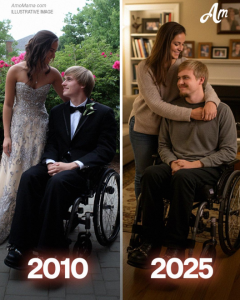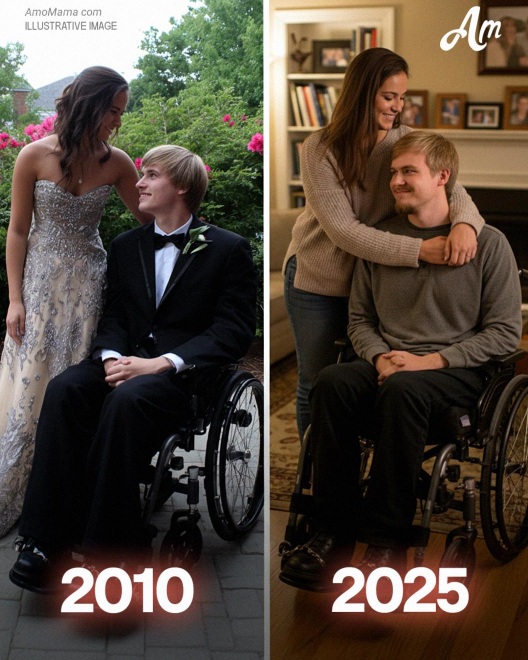
I Gave Up My Family for My Paralyzed High School Sweetheart – 15 Years Later, His Secret Destroyed Everything
When I was seventeen, I thought love was supposed to feel like gravity—unavoidable, powerful, and worth falling for even if you got hurt. That’s how it felt with Ethan. He was my high school sweetheart, the boy who waited for me by my locker every morning, who held my hand during scary movies and kissed my forehead when I cried about exams, my parents, my future. He was my first everything.
The night of the accident, I was supposed to be with him.
It had been raining. He was driving back from a part-time shift at the diner when a truck ran a red light and slammed into the driver’s side of his car. By the time I reached the hospital, his parents were already there, pale and silent. A doctor took me aside and told me Ethan had suffered a spinal cord injury. He would never walk again.
I remember sitting beside his bed, holding his hand while machines beeped around us. His eyes opened slowly, and when he saw me, he tried to smile.
“I’m still here,” he whispered.
And in that moment, I decided I would be too.
My parents begged me not to throw my life away. They said I was too young to tie myself to tragedy. They warned me about the sacrifices, the exhaustion, the resentment that would come. But love doesn’t listen to logic at seventeen. I chose Ethan.
They disowned me.
I moved in with him and his mother. I worked two jobs while finishing school. I helped him learn how to transfer from bed to wheelchair, how to bathe, how to dress. I fed him when his hands shook too badly to hold utensils. I became his caregiver, his partner, his world.
And for a long time, I believed he was mine.
We built a life together. Not the one we dreamed of, but one we could survive. I learned to live with less—less sleep, less freedom, less of myself. But I told myself it was worth it because love is supposed to be sacrifice.
Fifteen years passed.
By then, Ethan had become bitter. He hated his body. Hated his chair. Hated the world. And sometimes, I think, he hated me too—but I stayed. I always stayed.
Until the night his phone buzzed on the kitchen counter.
He was in the shower. I wasn’t snooping—I swear I wasn’t. But the screen lit up, and I saw a message preview.
“I miss your arms around me.”
My stomach dropped.
I didn’t touch the phone. I didn’t need to. The truth settled into my bones before my mind could catch up. When he came out of the bathroom, wrapped in a towel, I asked quietly, “Who’s Mia?”
His face went blank.
Then angry.
Then… tired.
“She’s someone who sees me as more than a patient,” he said.
I laughed. A broken, hollow sound. “So did I.”
He sat down heavily in his chair. “You see me as a responsibility.”
That hurt more than the betrayal.
I found out everything that night. Mia was a physical therapist he’d been seeing privately for months. They’d started talking. Then flirting. Then meeting after sessions. He said it wasn’t “physical” in the way I thought—but he didn’t deny it was emotional. And then he said the words that destroyed me:
“I’ve been pretending with you for years.”
Pretending.
I gave up my family. My youth. My dreams. For someone who was pretending.
But that wasn’t the worst part.
The worst part came when he admitted why he’d stayed with me in the first place.
“You made me feel safe,” he said. “And guilty. You built your life around me. I couldn’t leave.”
So he let me waste fifteen years.
I didn’t scream. I didn’t cry. I just went numb.
That night, I packed one bag.
He watched from his chair, silent. For the first time in fifteen years, he didn’t ask me to stay.
I walked out into the cold, shaking—not from the weather, but from the realization that I had given everything to someone who had already let me go.
The next morning, I went to my parents’ house.
I hadn’t seen them in over a decade.
My mother opened the door and froze. My father stood behind her. For a moment, no one spoke. Then she started crying. Then I did too. They didn’t say “I told you so.” They just pulled me inside.
And for the first time in fifteen years, I slept without listening for a call for help in the night.
It took me a long time to forgive myself.
Not Ethan—for him, I felt only distance. But myself. For thinking love meant erasing who I was. For believing loyalty required silence. For confusing devotion with self-destruction.
Now, years later, I understand something I didn’t back then:
Love is not supposed to cost you your entire identity.
Love is not supposed to make you smaller.
Love is not supposed to survive on guilt.
Ethan taught me about sacrifice. But leaving him taught me something better—about boundaries, dignity, and the courage it takes to choose yourself after choosing someone else for far too long.
I didn’t abandon him.
I finally stopped abandoning me.