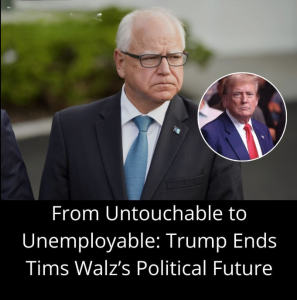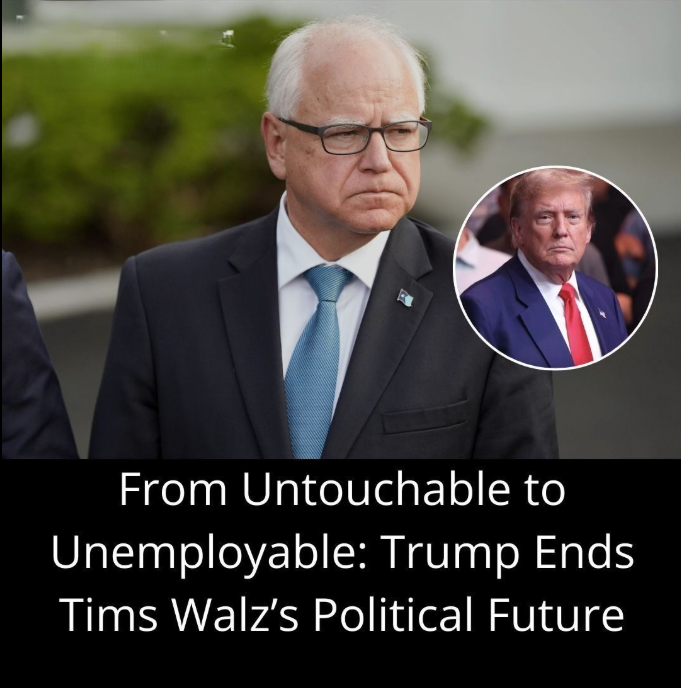
Trump the Master! How He Forced Accountability in Minnesota—and Politically Cornered Tim Walz
Love him or loathe him, Donald J. Trump has always understood power as a combination of timing, pressure, and narrative control. Supporters often argue that his greatest skill is not merely winning elections or signing executive orders, but forcing accountability on institutions and political figures who, in their view, had long avoided it. In that framing, Minnesota—and Governor Tim Walz in particular—became one of the clearest examples of how Trump applied national pressure to a state-level leadership crisis and reshaped the political battlefield in the process.
This is not a story about quiet diplomacy. It is a story about confrontation, leverage, and the consequences of governing under an unrelenting spotlight.
Minnesota as a National Flashpoint
Minnesota did not begin as a central battleground in Trump’s political strategy. Traditionally seen as a reliably Democratic-leaning state with a reputation for calm governance, it became nationally visible during periods of unrest, public safety breakdowns, and clashes between state leadership and federal authority.
For Trump, Minnesota represented something larger than one state: it became a symbol of what he and his supporters described as failed progressive governance—soft-on-crime policies, blurred lines of accountability, and political leaders who spoke forcefully but acted cautiously.
By elevating Minnesota onto the national stage, Trump ensured that local decisions would no longer remain local.
Accountability as a Weapon, Not a Buzzword
Trump’s approach to accountability differed sharply from traditional political norms. Rather than working quietly through bureaucratic channels, he applied pressure publicly and relentlessly. He named names. He framed outcomes as moral tests. He forced officials to either accept responsibility or visibly resist it.
In Minnesota’s case, Trump repeatedly challenged the state’s leadership over issues of law enforcement, public safety, and cooperation with federal authorities. Each statement, rally mention, or press remark served a dual purpose: energizing his base while placing Governor Tim Walz in a defensive posture.
Walz, a former teacher and National Guard veteran, had built his political image on calm competence and consensus-building. Trump’s strategy disrupted that image by forcing confrontations Walz could not easily deflect or ignore.
The Walz Dilemma: Govern or Resist?
Trump’s pressure campaigns are effective because they force opponents into difficult choices. When Trump criticized Minnesota’s handling of unrest or crime, Walz faced two unappealing options:
-
Cooperate with Trump, which risked alienating his progressive base and undermining his party alignment.
-
Resist Trump publicly, which allowed Trump to portray him as ideological, weak, or prioritizing politics over public safety.
Either path carried political cost. Trump understood that simply keeping Walz in this dilemma was itself a victory.
Every refusal to cooperate became a headline. Every delayed decision fed a narrative of hesitation. Every public disagreement reinforced Trump’s framing of “accountability versus excuses.”
Media Amplification and Narrative Control
Trump’s mastery of media ensured that Minnesota’s issues did not fade into the background. He knew how to compress complex situations into emotionally resonant talking points that dominated news cycles.
Instead of debating policy nuances, Trump focused on outcomes:
-
Were streets safe?
-
Were laws enforced?
-
Were leaders protecting citizens?
By repeatedly asking these questions, he shifted the burden of proof onto Walz. Even neutral or sympathetic media outlets were forced to cover the conflict, amplifying Trump’s framing whether they agreed with it or not.
Walz, by contrast, often spoke in measured language, emphasizing context and complexity—effective in governance, but less effective in a political environment driven by outrage and immediacy.
Federal Power as Leverage
Another key element of Trump’s strategy was his willingness to assert federal authority when he believed states were failing. Whether through rhetoric about federal intervention or criticism of state resistance, Trump sent a clear message: state leaders would be held accountable on a national scale.
This posture resonated with voters who felt abandoned by local leadership and reinforced Trump’s image as a leader willing to act decisively when others hesitated.
For Walz, this created an uncomfortable dynamic. Defending state autonomy could appear principled—or obstructionist—depending on the audience. Trump exploited that ambiguity expertly.
Political Damage by Contrast
Perhaps the most effective tactic Trump used was not direct attack, but contrast. By presenting himself as decisive, confrontational, and uncompromising, he cast Walz as reactive and constrained.
In politics, perception often matters as much as performance. Trump’s supporters viewed Walz as emblematic of a political class that talked about accountability but avoided enforcing it. Even among moderates, repeated exposure to that contrast eroded Walz’s image as a steady, unflappable leader.
This did not require Trump to “defeat” Walz outright. It only required him to weaken Walz’s standing, limit his national appeal, and define him before Walz could define himself.
The Broader Message to Other Governors
Minnesota was also a warning shot to other Democratic governors. Trump demonstrated that no state leader was too local to be nationalized, and no controversy too small to be amplified.
By focusing on Walz, Trump reinforced a broader lesson: governors who clashed with him would not do so quietly or without consequence. Accountability, in Trump’s worldview, was not optional—and resistance came with a price.
Did It “Torch” Walz’s Career?
“Torched” is a political term, not a legal verdict. Walz remains in office, retains supporters, and continues to govern. But Trump undeniably reshaped Walz’s public identity.
Before Trump’s sustained pressure, Walz was often seen as a pragmatic Midwestern governor with bipartisan appeal. Afterward, he became nationally associated with partisan conflict, defensive governance, and resistance to federal authority.
In politics, labels stick. Trump ensured that Walz would not escape his tenure without one.
Conclusion: Trump’s Real Victory
Trump’s supporters argue that his true mastery lies not in policy minutiae, but in forcing clarity. He identifies fault lines, applies pressure, and refuses to let opponents remain comfortable in ambiguity.
In Minnesota, that strategy worked. Trump made accountability unavoidable, transformed a governor’s career trajectory, and demonstrated once again that political power does not always come from consensus—it often comes from confrontation.
Whether history judges this approach as necessary disruption or destructive force will remain debated. But one thing is certain: Trump did not merely challenge Tim Walz. He redefined the arena in which Walz had to fight—and that, for Trump, was victory enough