The Day the Sea Came Home: A Story of Survival, Loss, and Hope in the Flooded Town of Hirosato
No one in Hirosato slept well the night before the sea returned.
The wind had been restless since dusk, worrying the roofs and rattling the paper lanterns that still hung from last week’s festival. Fishermen, used to reading the moods of water and sky, felt something unfamiliar in the air—an unease that settled deep in the bones. The radio spoke in careful voices about a distant storm and unusually high tides, but Hirosato had heard such warnings before. The sea had always been a neighbor, sometimes loud, sometimes gentle, but never cruel.
Until that morning.
At dawn, the tide did not retreat.
Instead, it advanced.
The first sign was subtle: water pooling where it never had before, creeping across the stone road near the harbor. Children on their way to school stopped and stared, their reflections trembling in the shallow waves. Shopkeepers stepped outside and frowned. By the time the sun rose fully, the sea had crossed an invisible line—one drawn by generations who believed they understood its limits.
The siren wailed too late.
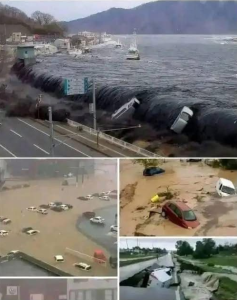
When the floodgates failed, the ocean surged into Hirosato with a force that felt personal, as if reclaiming something long owed. Boats broke free from their moorings and slammed into storefronts. Wooden homes shuddered, then gave way, their lives of laughter and quiet dinners spilling into the water. Salt filled the air, sharp and suffocating.
For Keiko Tanaka, the sound she would never forget was not the crash of waves but the silence that followed. Standing on the second floor of her family’s house, clutching her grandson to her chest, she watched the street below disappear. Her husband’s fishing nets floated past the window like ghosts of a life only hours old. There was no time to grieve—only to survive.
Across town, Hiroshi Sato climbed onto the roof of the community center, hauling strangers up with raw, bleeding hands. He did not ask their names. He did not need to. In disasters, identity shrinks to breath, grip, and heartbeat. The water rose faster than anyone imagined, swallowing cars, signs, and memories with equal indifference.
Some did not make it.
An elderly couple, unable to leave in time. A fisherman caught between his boat and the pier. A mother separated from her child in the chaos. By midday, Hirosato was no longer a town—it was an archipelago of rooftops, clinging people, and unanswered prayers.
When the sea finally paused, exhausted rather than merciful, it left behind a silence heavier than the storm. Helicopters thudded overhead, lowering ropes and hope in equal measure. Survivors were pulled from their perches, soaked, shivering, and stunned by the simple miracle of still being alive.
In the evacuation center miles inland, loss settled in slowly. Lists were read. Names echoed in the room like stones dropped into water. Some names received no answer. Keiko sat on a thin mat, her grandson asleep against her shoulder, staring at nothing. Around her, others cried openly, while some stared ahead, untouched by tears yet hollowed by shock.
The days that followed were cruel in quieter ways. Mud coated everything. Photographs stuck together, faces blurred beyond recognition. The smell of seawater and rot clung to clothing and skin. People returned to where their homes had been and stood in disbelief, as if waiting for walls to reappear out of habit.
And yet—hope, stubborn and unwelcome at first, began to surface.
It appeared in the form of shared meals made from donated rice. In volunteers who arrived from distant towns, bowing deeply before lifting debris. In children who laughed while splashing in puddles their parents feared. Hiroshi, his hands bandaged, helped rebuild a neighbor’s door even though his own house was gone.
Hope also came from memory. Elders spoke of storms long past, of rebuilding after fire and war. “We are still here,” they reminded one another. “That means something.”
Months later, Hirosato would not look the same. Some families would never return. The shoreline would be redrawn, both on maps and in minds. Stronger barriers would rise, but so would a new understanding: that living by the sea means loving something that can never be fully controlled.
On the anniversary of the flood, the town gathered near the rebuilt harbor. Lanterns were set afloat, each carrying a name, a wish, or a quiet apology. As they drifted outward, the sea reflected their light—not as an enemy, but as a witness.
The day the sea came home took much from Hirosato. Lives. Homes. Certainty.
But it did not take everything.
What remained was a town bound not just by geography, but by survival. By the knowledge that even when the water rises and the world dissolves into chaos, people can still choose to reach for one another.