When Appearance Becomes a Scandal: A Teacher, a Classroom, and the Power of Perception
In the age of smartphones and viral content, a single image can ignite controversy faster than any official investigation ever could. One such case involved a teacher whose classroom photos circulated rapidly online, sparking outrage, speculation, and ultimately disciplinary action. What began as ordinary moments captured during a lecture turned into a global debate about professionalism, perception, and the fragile boundary between personal expression and institutional expectations.
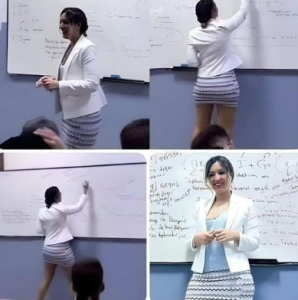
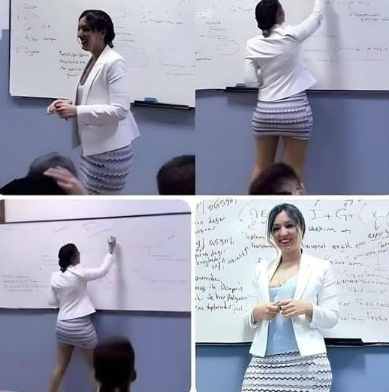
The images show a young female teacher standing at a whiteboard, writing equations and engaging with her class. She is dressed in a fitted blazer and a patterned skirt—an outfit that, by everyday standards, would not appear extraordinary. Yet once these images left the confines of the classroom and entered the digital public square, they were stripped of context and reframed through a far more judgmental lens.
Critics were quick to accuse the teacher of “provoking” students, suggesting that her attire was inappropriate for an academic environment. Some online commentators went even further, fabricating claims that crossed into serious and unsubstantiated allegations. These narratives spread rapidly, fueled by sensational headlines designed to provoke outrage rather than encourage understanding.
What is often overlooked in such cases is how easily authority figures—especially women—become targets of disproportionate scrutiny. Male educators rarely face comparable backlash for their clothing choices, yet female teachers are frequently judged against vague and inconsistent standards. What one person sees as professional, another may label as distracting, and social media tends to amplify the harshest interpretations.
School administrators soon found themselves under pressure. Parents demanded explanations, online petitions circulated, and media outlets framed the story as a morality issue rather than a professional one. In response, the institution placed the teacher on leave pending review, a move that many interpreted as an admission of wrongdoing—even though no formal misconduct had been proven.
This highlights a critical problem in modern discourse: the rush to judgment. When accusations go viral, due process often becomes an afterthought. Institutions act defensively to protect their reputations, sometimes at the expense of fairness. In this case, the teacher’s teaching record, student performance, and professional evaluations were overshadowed by a few images taken out of context.
Educational experts argue that professionalism should be measured by conduct, competence, and respect—not by subjective interpretations of appearance. A classroom is meant to be a place of learning, and responsibility for maintaining focus lies with institutional structure, clear policies, and mutual respect—not with policing bodies based on public opinion.
There is also a deeper societal issue at play: the tendency to conflate appearance with intent. Suggesting that clothing alone can “cause” distraction places an unfair burden on educators, particularly women, while ignoring the role of proper classroom management and student accountability. It sends a troubling message that responsibility can be shifted away from behavior and onto bodies.
The teacher at the center of this controversy largely remained silent throughout the ordeal. Friends and colleagues described her as dedicated, organized, and passionate about her subject. Former students spoke of her clarity in teaching and her willingness to offer extra help after class. These voices, however, struggled to compete with the louder, more inflammatory narratives dominating social platforms.
As the situation unfolded, discussions expanded beyond this single case. Educators worldwide began sharing their own experiences with dress code ambiguity, inconsistent enforcement, and fear of misinterpretation. Many expressed concern that teaching—already a demanding profession—was becoming even more precarious under constant digital surveillance.
Eventually, the school announced its decision to terminate the teacher’s contract, citing “professional standards.” The statement was brief and carefully worded, leaving many questions unanswered. Was this a genuine policy violation, or a strategic move to quiet public backlash? The lack of transparency only fueled further debate.
What remains after the headlines fade is an important lesson about how quickly narratives can spiral out of control. In an era where images travel faster than facts, reputations can be damaged beyond repair before truth has a chance to surface. The consequences are real, affecting livelihoods, mental health, and long-term career prospects.
This case forces society to confront uncomfortable questions. How much power should online opinion hold over professional decisions? Where do we draw the line between personal expression and institutional conformity? And most importantly, how do we protect individuals from being reduced to viral caricatures?
Education thrives on trust—between teachers and students, institutions and families, professionals and the communities they serve. When that trust is undermined by sensationalism and assumption, everyone loses. The classroom becomes a battleground for perception rather than a space for growth.
In the end, this story is less about a single teacher and more about the culture that judged her. It is a reminder that responsibility, fairness, and critical thinking are values that must extend beyond textbooks and into how we treat one another—both online and off.