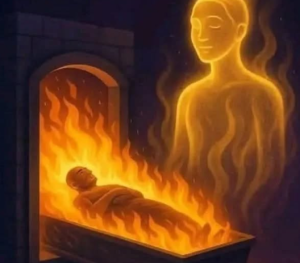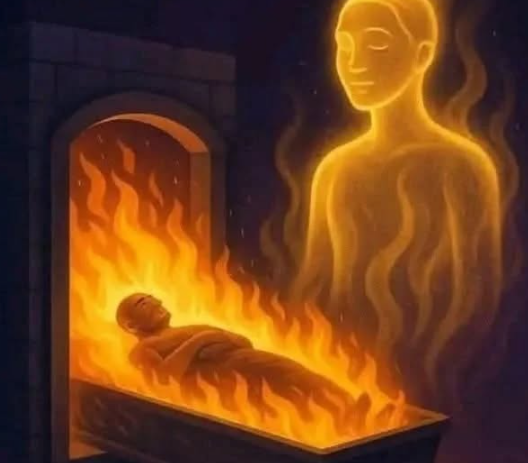
THE SIN OF CREMATION—What the Bible Really Says: The Story Behind a Controversial Belief
For generations, whispers have circulated through churches, prayer groups, and late-night Bible discussions: “Cremation is a sin… the Bible forbids it… God will not raise the burned body.”
These statements float around like half-remembered warnings, passed down from elders who believed them with trembling sincerity. But few ever stop to ask: Where did these beliefs begin? What does Scripture actually say—clearly, directly, undeniably? And why has this topic stirred so many emotions across Christian families?
To understand the debate, we must first step backward into a world where burial was not merely a cultural act, but a sacred symbol.
Part I: The Ancient Roots of Burial
In the Old Testament, burial was more than tradition—it was a sign of dignity, honor, and hope. Abraham purchased the cave of Machpelah to bury Sarah, establishing a burial site that would become the resting place of patriarchs for generations. Jacob insisted that his bones be carried back to the Promised Land. Joseph, even in death, asked the Israelites to take his remains home centuries later.
Burial wasn’t just disposal of a body.
It was a declaration: “I belong to God. My life will rise again.”
Yet even here, the Bible never states:
“Cremation is a sin.”
Still, many believers connected cremation with pagan practices—nations who burned their dead as offerings or sacrifices to false gods. In ancient Israel, fire often symbolized judgment, wrath, or destruction. So to some early interpreters, cremation instinctively felt “wrong,” even if Scripture did not plainly forbid it.
Part II: The Confusion That Sparked a Doctrine
Generations later, a misunderstood passage from the book of Amos deepened the suspicion. It described people burning bones on pagan altars as an act of desecration. Some Christians mistakenly merged this with funerary practices and concluded that cremation itself dishonored the dead.
But the text condemns pagan ritual, not cremation.
Another confusion came from the promise of resurrection. Believers imagined God gathering the bones together like Ezekiel’s vision in the valley of dry bones. If the bones were gone—ashes scattered into the wind—how could resurrection occur?
The early church fathers struggled with this question too. Some avoided cremation altogether. Others boldly declared:
If God created the universe out of nothing, He can resurrect a body out of ashes.
Still, fear persisted.
Part III: A Family’s Dilemma
In modern times, the debate continues. This story emerged from a small town where a family sat at a wooden table under a dim kitchen light. A mother, Maria, had passed away unexpectedly—faithful, gentle, and deeply rooted in Scripture. She left no instructions regarding her burial.
Her daughter, Lydia, believed cremation would respect the planet, save costs, and simplify arrangements.
But her father, David, felt a heavy weight on his chest. His parents had warned him since childhood:
“Never burn the body God formed with His own hands.”
He remembered verses about the body being the “temple of the Holy Spirit.” He felt, without being able to explain why, that fire was disrespectful.
Yet when Lydia asked him, “Dad… where in the Bible does it say cremation is a sin?” he had no answer.
So he opened the Scriptures.
He searched Genesis through Revelation. He expected thunderous warnings, divine laws, or prophetic rebukes. Instead, he found:
-
Saul’s and Jonathan’s bodies burned, then buried respectfully.
-
Moabites condemned not for burning bodies, but for doing so in mockery.
-
Countless righteous people buried, but no command that burial is the only acceptable choice.
Slowly, painfully, David realized the truth:
The Bible does not call cremation a sin.
Cultural practices? Yes. Symbolic preferences? Yes. But divine law? No.
He sat back in his chair, exhausted.
The “rule” he had feared for decades had never been written by God.
Part IV: What the Bible Actually Teaches
The Bible consistently teaches three things about the body:
-
It is created by God.
-
It returns to dust—whether slowly in a grave or quickly in fire.
-
God will resurrect it in His power, not by our preservation techniques.
Job declared:
“After my skin has been destroyed, yet in my flesh I shall see God.”
Destroyed how? He didn’t say. Because it didn’t matter.
Paul wrote that the resurrection body will be new, transformed, glorified. Not pieced together bone by bone from the old. Not reconstructed like an archaeological dig. A body powered not by biology, but by divinity.
If God resurrects the martyrs burned at the stake, the sailors lost at sea, the bodies dissolved by time, then surely cremation presents no barrier to Him.
Part V: Why the Debate Still Matters
If cremation isn’t a sin, why do people still argue about it?
Because funeral choices are emotional, symbolic, and deeply personal.
They reflect our beliefs about life, death, and eternity.
For some Christians, burial honors tradition and conveys hope.
For others, cremation symbolizes release, simplicity, or stewardship.
Both can be acts of faith—depending on the heart.
What is a sin, however, is the judgment and division that often arises around the topic. Jesus warned against elevating human tradition to the level of divine command. When people declare:
“Cremation sends you to hell,”
they speak where God has remained silent.
And Scripture is clear:
Only God’s Word—not folklore, not rumors, not fear—defines sin.
Part VI: The Final Lesson
On the day of Maria’s memorial, David stood at the front of the small church holding a simple urn. He wept—not because she had been cremated, but because he had learned something profound:
Faith is deeper than fear.
Resurrection is stronger than fire.
And God’s power is not limited by our methods.
He felt peace, knowing that the ashes in the urn were still in the hands of the Creator who shaped galaxies from nothing.
In the end, the “sin of cremation” was not a biblical command.
It was a misunderstanding—born from fear, tradition, and centuries of misinterpretation.
But the truth, quiet and unchanging, remains:
Cremation is not a sin.
Sin comes not from how the body returns to dust,
but from the condition of the heart that returns to God.