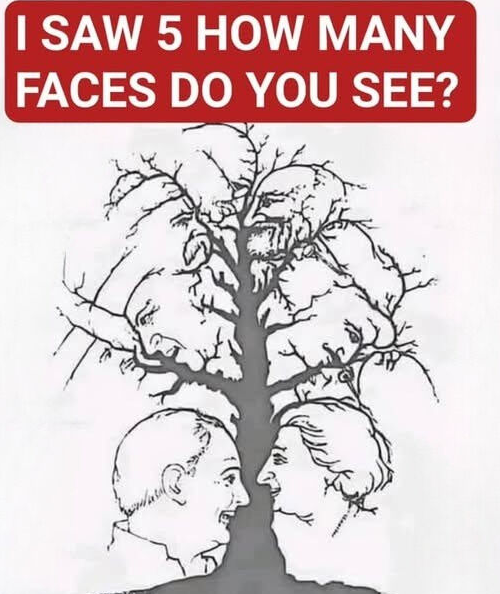
Can you spot every face in this optical illusion? At first glance, the image seems to be one thing — a swirl of shapes, lines, maybe a tangle of shadows — but when you look again, faces begin to appear. That moment of recognition is a small thrill: your brain, meant to find meaning in chaos, rewards you with pattern and story. Optical illusions that hide faces are among the most satisfying because they turn a passive picture into an active puzzle. Each time you find a new face, you feel like an explorer discovering a hidden village.
Start by letting your eyes wander. Don’t stare with intent; instead, drift across the composition as if listening for a whispered secret. Faces in illusions are often concealed through clever use of negative space — the area around and between objects that your eye can either ignore or reinterpret. A sweeping shadow becomes a jawline. Two dots of darkness become eyes. A bright curve suggests a smile. By shifting from foreground to background and back again, you allow your visual system the flexibility to reinterpret shapes and to create new groupings out of what once looked like random lines.
Next, change your focus. Try looking slightly out of the corner of your eye, or squint gently. Peripheral vision processes shapes differently than central vision; it is more sensitive to overall patterns and contrasts than to fine detail. Many hidden faces jump out when you blur small features and emphasize broader forms. If the illustration uses repeating motifs, rotate your head or the page; orientation can matter. Faces that hide when the image sits upright will sometimes leap into view when the canvas is tilted. Don’t be surprised if one face you missed earlier becomes obvious with a small change in perspective.
Now listen to your memory. Faces are social currency: we’re wired to read expressions and intentions. When your brain suspects a face, it searches for familiar configurations — two symmetrical marks over a central line, or a triangular arrangement of highlights. Once you find one face, the image’s visual grammar might reveal a dozen more. Look for patterns that repeat: a curve that could be an eyebrow in one spot, a cheek in another; a pair of dark shapes that could be eyes, applied in different sizes and set into different contexts. The same few strokes can play multiple roles depending on which lines you choose to join mentally.
Another trick is to mentally separate the image into layers. Imagine tracing a transparent sheet over the picture and then drawing the largest shapes you see. What remains when you erase the small details? Often the larger shapes encode face-like forms. Try isolating groups of three marks; human perception is adept at turning triads into faces. Also, search for implied symmetry. Even partial symmetry can suggest a face because we tend to expect two eyes, a nose, and a mouth to balance around an axis. When you sense an axis, fold the image mentally along that line — you’ll see how one half suggests the other, forcing a face into view.
If you want to push further, give names to the faces you find. Naming transforms a visual exercise into a narrative hunt. Suddenly, a shadowed profile becomes “the old sailor,” another pair of dots becomes “the surprised child,” and a faint smile becomes “the performer about to bow.” Names anchor fleeting impressions, making it easier to spot those same faces again and to notice new ones nearby. You’ll be surprised how assigning personality helps you find faces you missed on your first pass.
Consider also the role of light and contrast. Artists hide faces where brightness and darkness meet; edges and midtones act like signposts. High-contrast zones shout their presence, but faces are often tucked into subtle midtone transitions where the eye hesitates. So pay attention to gradations as well as stark outlines. A subtle shift from warm to cool tone can be enough to form the suggestion of a cheek or an ear. Shadows that at first seem meaningless can turn into hairlines or the hollow beneath a cheekbone when seen in the right light.
If the image is dense, break it into smaller windows. Cover parts of the illustration with your hand or a piece of paper to focus on one section at a time. This reduces visual noise and increases the chance of finding faces that were previously lost in the bustle. After exploring each window, remove the cover and notice how the faces you found interact with those next to them. Often faces are designed to interlock, sharing lines and shadows that serve double duty. One contour might be a nose for one face and the eyebrow for another, depending on how you contextualize it.
Delight in the ambiguity. Optical illusions thrive because they sit on the border of clarity and confusion. Instead of trying to force every hidden face into view at once, celebrate the gradual unfolding. Some faces will be immediate and obvious; others will require a patient, playful eye. And when a face refuses to appear, step away. Returning with fresh attention often yields new discoveries. The brain needs breaks; odd as it sounds, resting your gaze helps the mind recombine elements in new ways.
Finally, remember why these illusions fascinate us. They expose the machinery of perception: the shortcuts, expectations, and biases our minds use to construct reality. Finding a face is a small victory that reveals a bigger truth — our world is as much created by the mind as it is recorded by the eyes. Those hidden faces are mirrors of our own tendency to find meaning, to assemble fragments into stories, and to insist on company even in solitary pictures. They remind us that seeing is an act of imagination.
So, did you spot every face? Maybe not yet. Keep looking, change your angle, name the characters you see, and enjoy the quiet thrill that comes each time another face takes shape. Optical illusions that hide faces are invitations — invitations to slow down, to let pattern emerge, and to take pleasure in the surprising ways perception can surprise us. In that sense, the game goes beyond counting faces; it becomes a gentle lesson in how we look, think, and imagine. Keep a small notebook nearby; jot your discoveries — it turns fleeting sightings into a map of your perceptual journey.